Sougata Roy
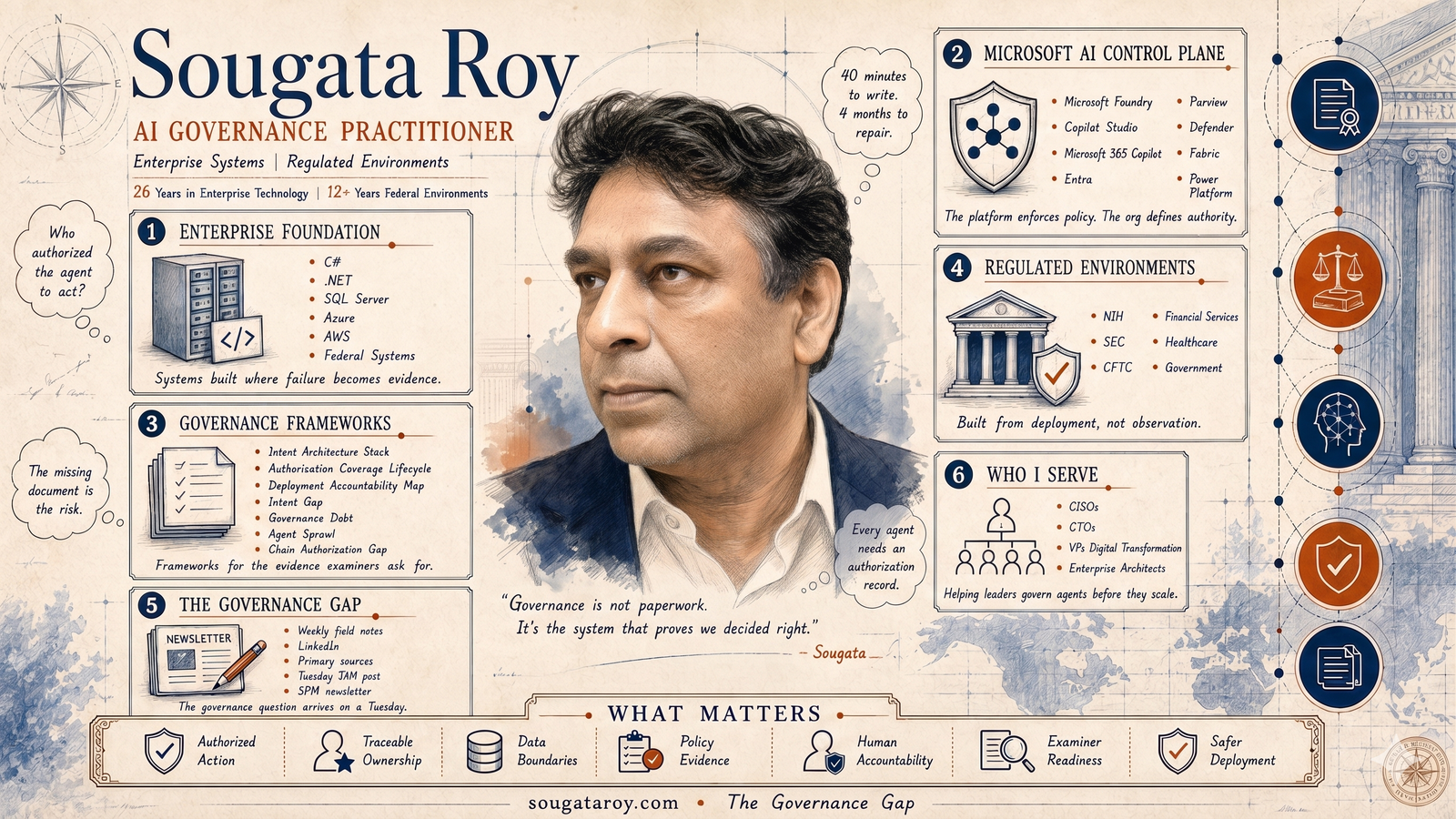
Sougata Roy is a technology manager with 26 years building enterprise systems, including 13 years on federal engagements at agencies such as the SEC, CFTC, and NIH. He writes The Governance Gap, a weekly newsletter on enterprise AI governance and the accountability question that agent deployment forces every regulated organization to confront.
Career history is listed independently in the NIH Office of Technology Transfer staff directory(opens in new tab).
The frameworks here exist because the accountability question has no default answer.
Perspective
Experience
26+
Years building enterprise systems
Federal engagements
13
Years as a contractor
Focus
Regulated AI governance
Accountability evidence for enterprise AI systems
Independence
The research and frameworks published here are independent work developed on Sougata Roy's own time and resources from publicly available primary sources, supplemented where appropriate by independent technical validation in controlled, non-client environments.
They do not derive from employer or client systems, confidential engagements, or non-public operational information. Every example, incident, and capability claim is drawn from a named public document carrying the date it was verified, independently validated in a controlled non-client environment, or flagged as a constructed illustration.
The Research Basis
Professional experience provides context. Public evidence provides the research basis.
AI governance grounded in primary-source research and independent technical validation.
The research and frameworks published here are independent work developed on Sougata Roy's own time and resources from publicly available primary sources, supplemented where appropriate by independent technical validation in controlled, non-client environments.
Across regulatory guidance, platform documentation, standards, published research, and public incident records, a recurring gap becomes visible. Teams can have logs, access controls, and review processes, and still lack the written record showing who authorized an agent to act.
The frameworks on this site address that gap. They are designed as operational frameworks, not abstract commentary, and they organize the evidence leaders need when deployment, review, and accountability have to work together.
The Intent Architecture Stack was developed to address environments where the accountability question has no clear default answer. It gives the authorization record a structure before an agent goes live.
The Accountability Assumption names a recurring pattern documented across regulated AI governance material. Monitoring exists. Evidence exists. The missing record is the one saying who authorized the agent to act.
Writing the record is estimated at forty minutes. Repairing its absence after a review is estimated in months.
They do not derive from employer or client systems, confidential engagements, or non-public operational information. The frameworks and terminology are Sougata Roy's independent synthesis.
Book
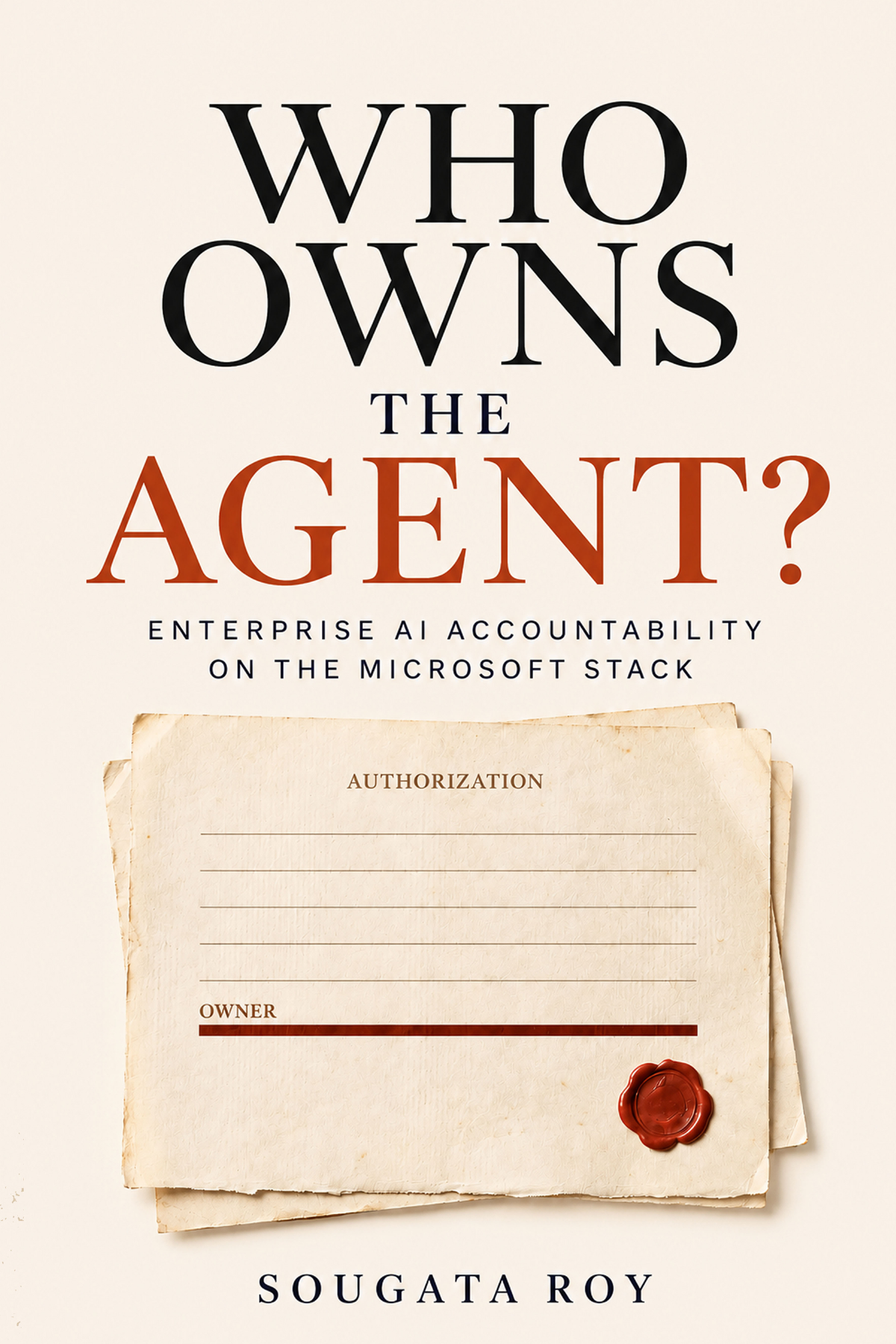
Who Owns the Agent?
Enterprise AI Accountability on the Microsoft Stack
The August 2026 first-edition paperback is the central record for this work: the accountability question, the Microsoft stack, and the authorization record every deployed agent needs.
White paper
Who Owns the Agent?(opens in new tab) publishes the Intent Architecture Stack as a formal accountability pattern.
Zenodo DOI: 10.5281/zenodo.20481551(opens in new tab)
Framework library
The Authorization Layer(opens in new tab) compiles the site's enterprise AI agent governance frameworks into a citable Zenodo record.
Zenodo DOI: 10.5281/zenodo.21245690(opens in new tab)
Newsletter
The Governance Gap
Ongoing observations published every Tuesday on LinkedIn.
Frameworks
Operational models
Nine operating models for accountability, authorization, and governance design.
Intelligence
Dated field notes
More than forty sourced observations on AI governance, security, compliance, and accountability.
Open frameworks and site terminology are available under CC BY 4.0. The paperback is a separate published book and is not covered by that reuse notice. Full terms for open materials at sougataroy.com/rights
Contact
If something here landed for you, if a framework named a problem you have been carrying or an essay described a meeting you have already been in, I want to hear what it was.
Questions about the research or the governance questions it raises are welcome by direct message on LinkedIn.
Views expressed are my own and do not represent any employer, client, or agency.