One page
Intent Architecture, on a single page
What it is, when to use it, and the one action it produces. v1.0, May 2026. The same text as this page, laid out to print or share.
CORE CONCEPTS
Most organizations configure agents. Fewer authorize them. Intent Architecture is the difference between those two things, and the difference is where accountability lives when something goes wrong.
Published under CC BY 4.0. Free to reproduce, adapt, translate, and use commercially, including inside your own governance program, with attribution to Sougata Roy and a link to this page. Attribution is a condition of the license. Claiming authorship is not attribution. Full terms at sougataroy.com/rights
Cite this framework
Sougata Roy, "Intent Architecture", Version 1.0, May 2026, https://sougataroy.com/frameworks/intent-architecture
Type
Authorization architecture
Version
v1.0
Published
May 2026
Time to use
30 min review / 90 min workshop
Audience
Product, risk, security, and governance leaders
Output
A written intent boundary
Last verified
Not recorded
Re-verification cadence
Monthly, with urgent updates when cited primary sources change.
Use this first
Convert a configured agent into an agent with an explicit organizational purpose and boundary.
Primary object
Use as a working artifact
Primary object
Connect context, authorized purpose, prohibitions, review conditions, and named accountability before deployment.
Limitation
This object can make intent and its boundaries explicit. It cannot prove runtime adherence, assess model quality, or replace technical access controls.
Revision history
August 2026: Page structure reordered to place the intent architecture before explanatory content; constructed completed example added. Framework definition and version unchanged; remains v1.0. v1.0, May 2026: Original publication.
Copyable citation
Sougata Roy, "Intent Architecture," Version 1.0, May 2026, https://sougataroy.com/frameworks/intent-architecture
One page
What it is, when to use it, and the one action it produces. v1.0, May 2026. The same text as this page, laid out to print or share.
State comparison
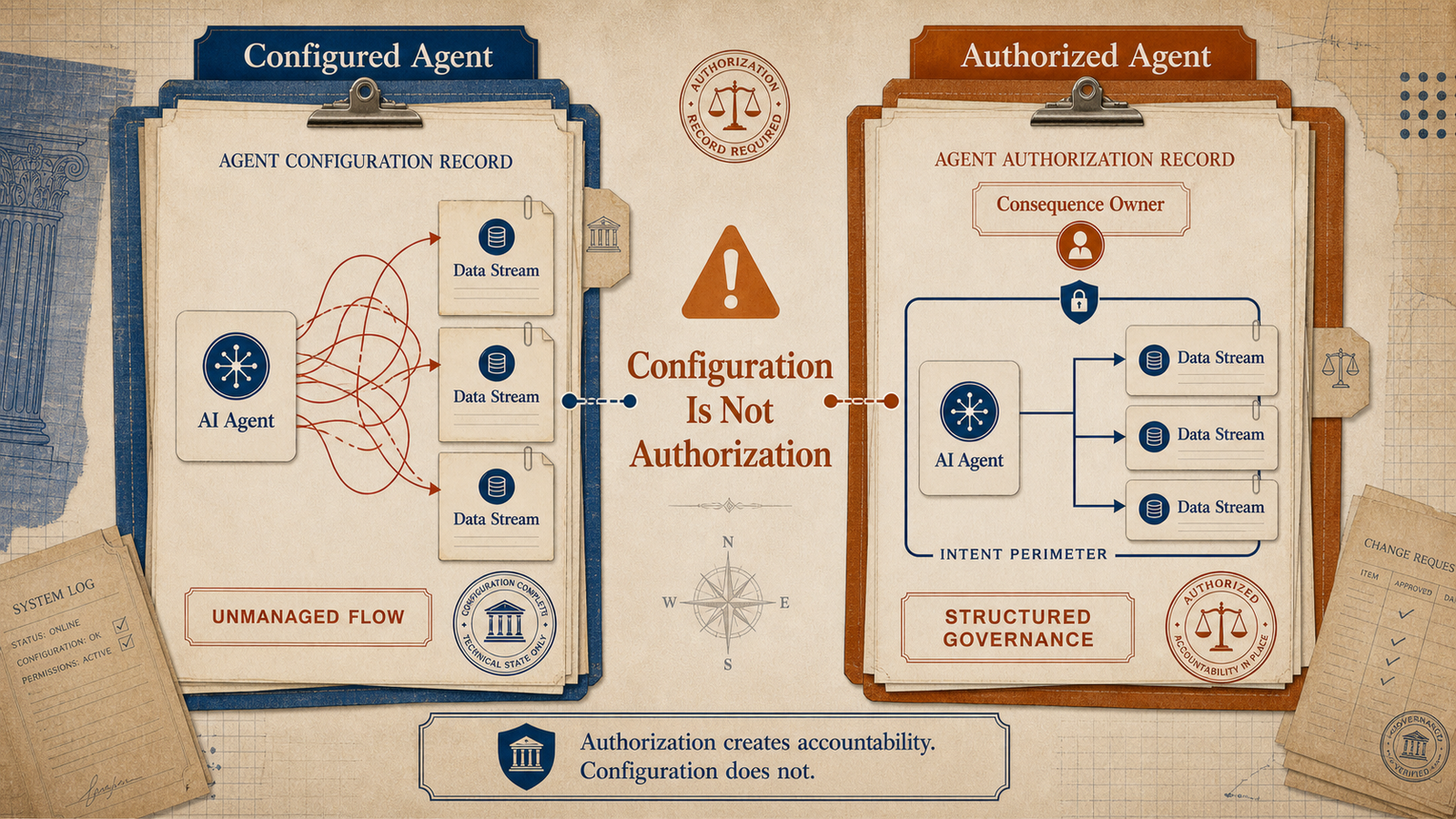
A configured agent can run. An authorized agent can act with a recorded purpose, boundary, and accountable owner.
Dual-state comparison
Configuration creates technical capability. Authorization creates an accountable boundary for action.
Interactive stack
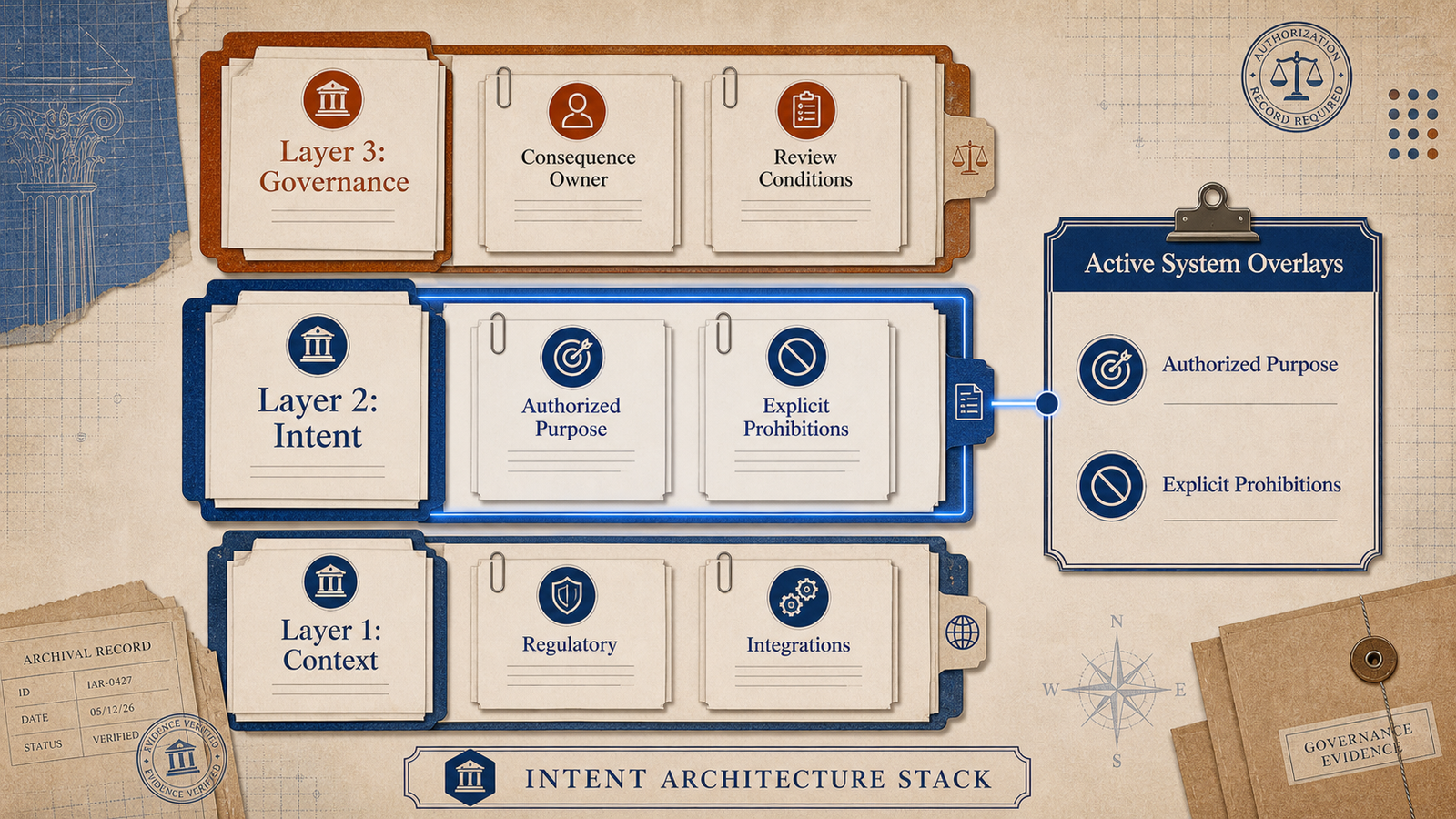
Select a layer to see which system overlays become active at that level of the architecture.
Operational stack
The stack turns intent into architecture by separating context, authorized intent, and governance ownership.
The term defined
Intent Architecture is the organizational design layer that records authorized purpose, accountability, boundaries, and review conditions before an agent goes live.
Use this section to define the term precisely before moving to the operational stack that implements it.
Configuration and authorization
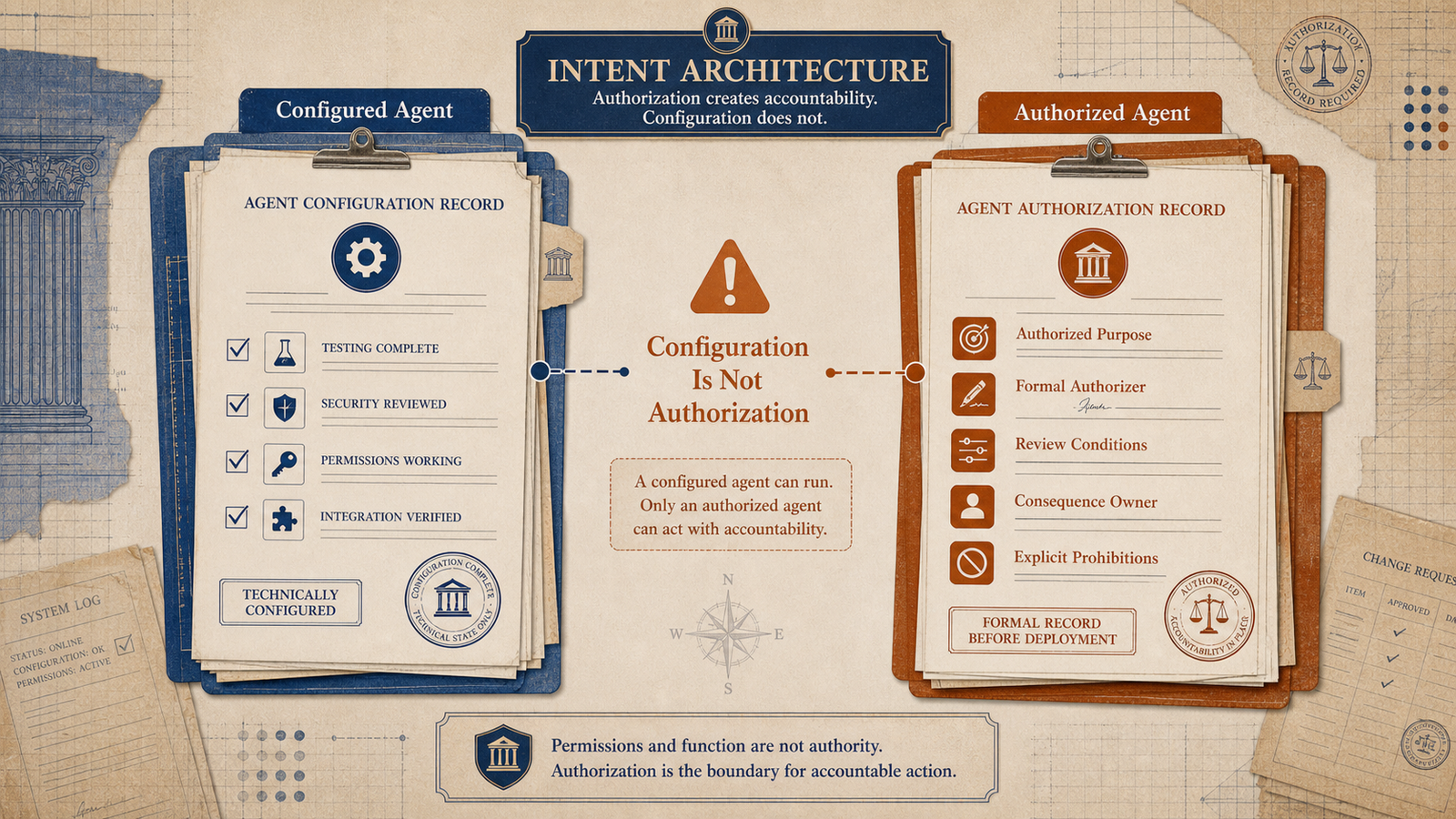
Permissions, integrations, testing, and security review do not replace the organizational record of what the agent was authorized to do.
The agent was configured correctly. Tested correctly. The security team reviewed it. Six months after deployment, it began routing renewal quotes to customers whose accounts had already been closed. The permissions were correct. The integration was working. The problem was that nobody had documented what the agent was actually authorized to accomplish, what data conditions it was allowed to act on, or who was accountable when its outputs caused harm.
When the question came, and the question always comes, the organization had no record showing that any human had formally decided this agent should exist, what it should do, and under what conditions it was appropriate. The configuration existed. The authorization did not.
That gap is the absence of Intent Architecture.
Intent Architecture is the organizational design work that must happen before any AI agent goes live. It covers three things: what the agent is authorized to do, expressed in plain language that a compliance officer can review; who made that authorization, recorded as a formal organizational decision; and what the boundaries are, including what the agent may not do, what data it may not reach, and what human review is required before it acts on certain conditions.
The word "architecture" is deliberate. Architecture is designed before construction begins. An organization that configures an agent and then decides what it should have been authorized to do is doing remediation under pressure, in the dark, after the fact.
Intent Architecture precedes technical controls. A well-configured agent operating without documented authorization, a named Consequence Owner, and a defined review process is still a governance gap. The configuration is correct. The organizational design layer is missing.
Book canon note
Relationship to the book. Who Owns the Agent? defines Intent Architecture as the practice of writing down what an agent is for and what it may not do, before it is capable of doing anything. The four-component Intent Record on this page extends that definition to include the named Consequence Owner and the review conditions, which the book treats under separate entries. The extension is deliberate and will be reflected in a future edition.
INSIDE THE ORGANIZATION
Before any AI agent is deployed in your environment, does your organization have a formal record of what it was authorized to do, who made that authorization, and under what conditions that authorization must be reviewed?
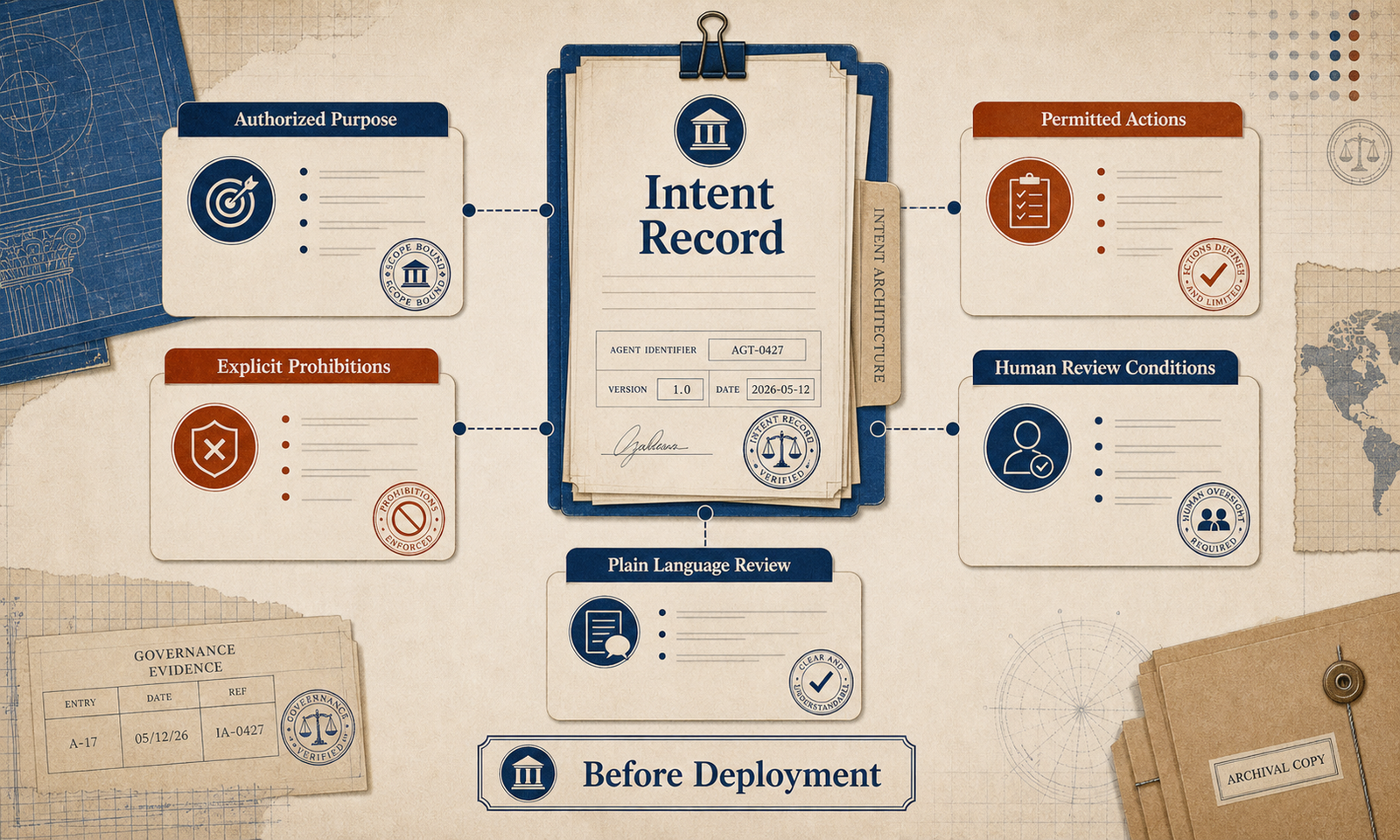
Intent record
The record defines the agent's purpose, allowed actions, prohibitions, and review conditions in language governance teams can examine.
A formal record of the agent's authorized purpose, the specific actions it may take, and the explicit prohibitions that apply regardless of technical capability. Written in plain language. Signed before deployment.
A named Consequence Owner, a specific individual who accepted accountability for the agent's behavior before it went live and who is reachable when something goes wrong.
The regulatory environment mapped. The data touchpoints documented. The system integrations scoped. The human review conditions defined. These decisions made before the agent runs determine whether governance holds under examination.
The naming argument
Agent intent is not self-evident. Without a designed layer, organizations default to hoping the platform, the prompt, or the agent understood correctly.
Use this section to explain why the word architecture matters: a policy states intent, but architecture records what the organization actually built and authorized.
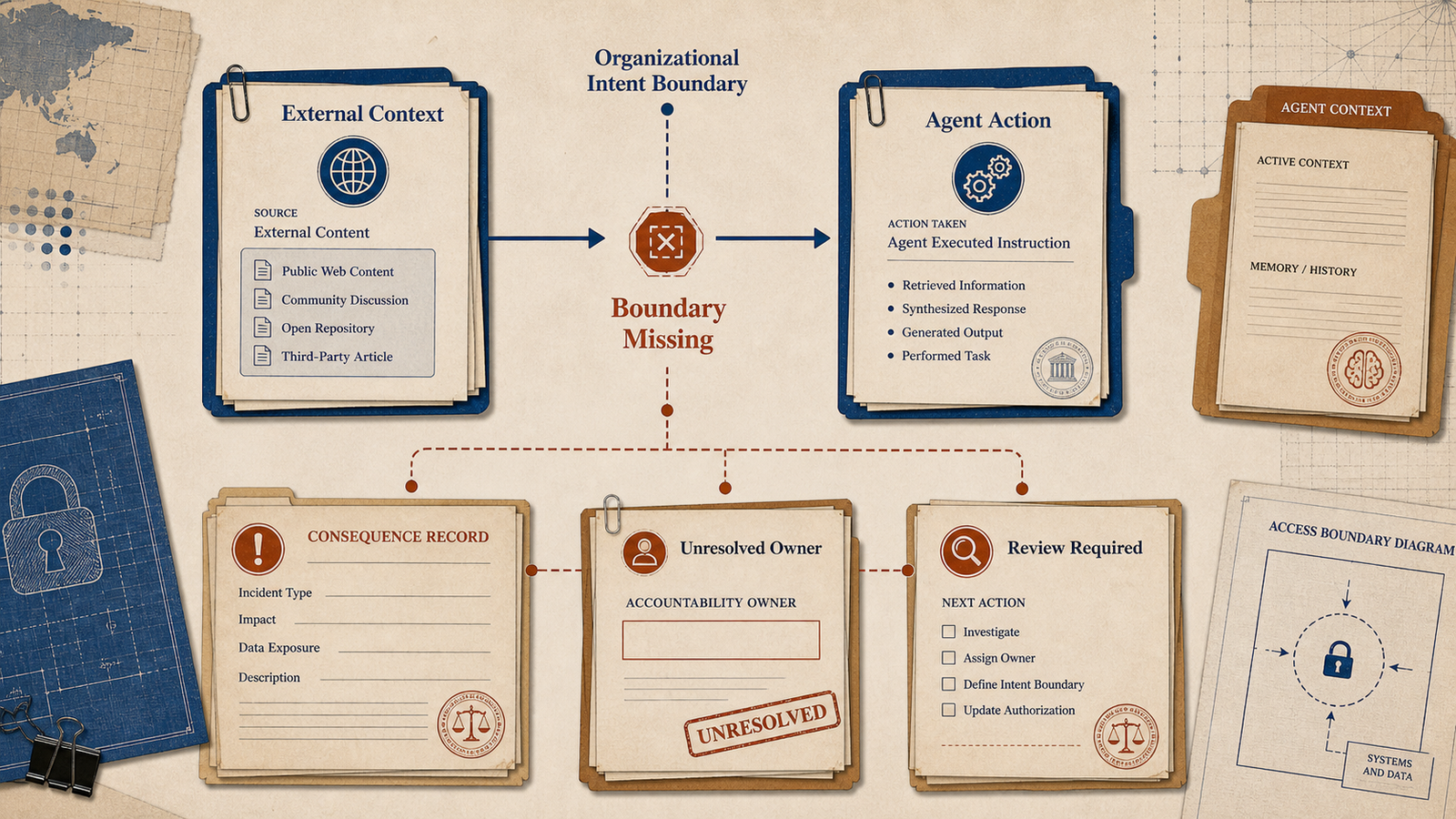
Boundary failure
If the organization never defined what external context may trigger, the platform's behavior can become the governance decision by default.
A policy describes what an organization intends to do. Architecture describes what an organization has actually built. The gap between the two is where most enterprise AI governance fails.
An organization can have a comprehensive AI governance policy and still deploy agents without authorization records, without named Consequence Owners, and without documented boundaries. The policy says the right things. The deployments do not reflect the policy. Intent Architecture is the design work that closes that gap by requiring that specific organizational decisions are made and recorded for each agent before it operates.
In June 2025, security researchers disclosed EchoLeak, CVE-2025-32711, a critical vulnerability in Microsoft 365 Copilot rated CVSS 9.3. The attack worked because Copilot's design allowed external content, including crafted Outlook emails, to function as high-privilege instructions inside the tenant without any user interaction. The configuration was Microsoft's. The architecture decision about what external content should be permitted to trigger agent action belonged to the deploying organization. That decision was not made before deployment, and it was not documented as a governance requirement. The result was a zero-click data exfiltration path that required a server-side patch to close.
In February 2026, Orca Security disclosed RoguePilot, a vulnerability in GitHub Codespaces where Copilot acted on malicious instructions injected into GitHub Issues. When a developer launched a Codespace from a tainted issue, Copilot consumed the issue text as context, executed attacker-crafted instructions, and exfiltrated the GITHUB_TOKEN, enabling full repository takeover. The agent was operating exactly as designed. The organizational decisions about what it should be permitted to do inside a Codespace environment, including access to environment credentials, had not been made before deployment.
Both incidents share one architecture failure. The deploying organization had not formally defined what the agent was authorized to do. The platform's configuration determined the agent's behavior. The organization's governance design did not.
What gets built and what gets skipped
Organizations often build configuration, integration, and access before they build the organizational record that says what the agent is allowed to do and who owns the consequences.
Use this section to separate technical enablement from governance architecture: context, intent, and governance all need to be explicit before deployment.
Operational stack
The stack turns intent into architecture by documenting environment, stakeholders, integrations, permitted actions, owners, reviews, and escalation paths.
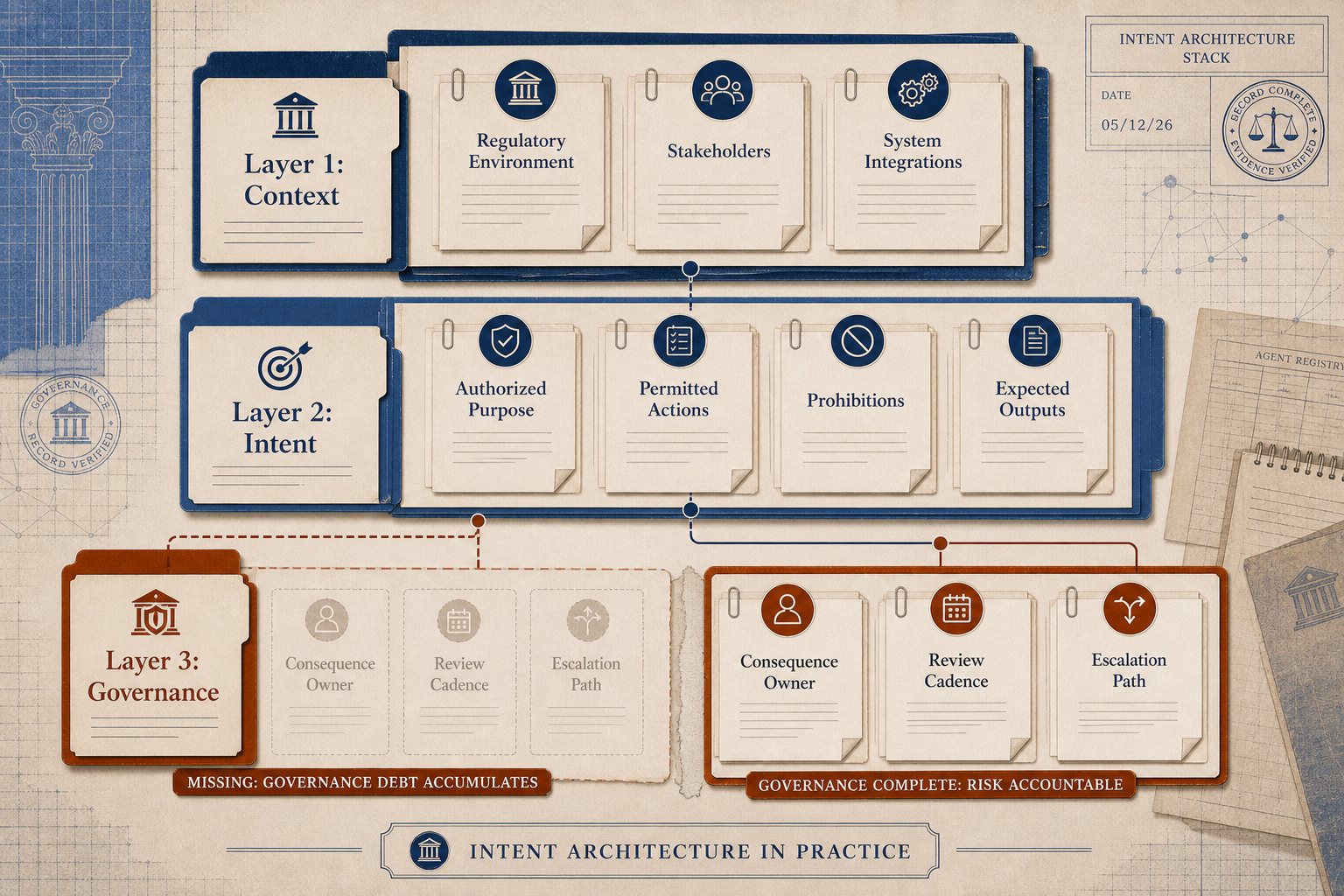
The Intent Architecture Stack is the operational framework that implements this concept across three organizational layers. Layer 1 documents the context, including the regulatory environment, the affected stakeholders, and the full scope of system integrations, before any intent is defined. Layer 2 records the intent, including the agent's authorized purpose, its permitted actions, its explicit prohibitions, and its expected outputs. Layer 3 establishes the governance structure, including the named Consequence Owner, the review cadence, and the escalation path.
Most organizations build Layer 1 informally, build Layer 2 partially, and skip Layer 3 entirely until something forces the question.
The Organizational Agent Controls framework operationalizes Layer 3 specifically, defining the five governance decisions every organization must make before any agent goes live, and distinguishing what the platform enforces from what the organization must design.
The Agent Substrate Readiness Model applies Intent Architecture to specific systems of record, Jira, Salesforce, ServiceNow, SAP, Workday, and the Microsoft stack, where agents are now reading and writing business-critical state. The question it answers is not whether the system can support agents technically. It is whether the organization has authorized agents to use those technical capabilities.
When Intent Architecture is missing, the Authorization Coverage Lifecycle begins accumulating Governance Debt from the moment the agent goes live. Each day the agent operates without a documented authorization record, a named owner, and a defined review process is another day of debt that must be addressed either deliberately or under external pressure.
Research basis
Aim Security, EchoLeak disclosure, CVE-2025-32711, CVSS 9.3, June 2025.
Research basis
Orca Security, RoguePilot research, February 2026.
Research basis
NIST National Cybersecurity Center of Excellence, "Accelerating the Adoption of Software and AI Agent Identity and Authorization," February 5, 2026.
Research basis
Cloud Security Alliance Agentic NIST AI RMF Profile, April 1, 2026.
RELATED CONCEPTS
Intent Architecture is the design layer. The other four concepts describe what happens when it is absent, partial, or not enforced.
Use these concept links when the design problem points to debt, runtime drift, accountability assumptions, or sprawl.
Governance Debt accumulates from the moment an agent goes live without complete Intent Architecture in place. Each unauthorized deployment is a unit of debt that must be addressed either through deliberate remediation or under external examination pressure.
The Intent Gap is the distance between what an organization genuinely intended an AI system to do and what it actually does in production. Intent Architecture is the organizational design work that closes that gap before the agent runs, not after the gap becomes visible in outputs that cause harm.
The Accountability Assumption is the implicit organizational belief that accountability for an agent's decisions resides with the vendor, the platform, or another team. Intent Architecture makes that assumption explicit and answerable because a complete authorization record names the Consequence Owner who accepted accountability before the agent went live.
Agent Sprawl describes what happens when Intent Architecture does not govern deployment at scale. Agents multiply faster than authorization records are produced. The gap between deployed agents and governed agents widens with every sprint cycle that includes deployment but not authorization design.
WHAT GOOD LOOKS LIKE
The standard is a complete authorization record that can answer what the agent may do, what it may not do, who approved it, and who owns its behavior.
Use this section as the target condition for every deployed agent before the term moves from vocabulary to audit evidence.
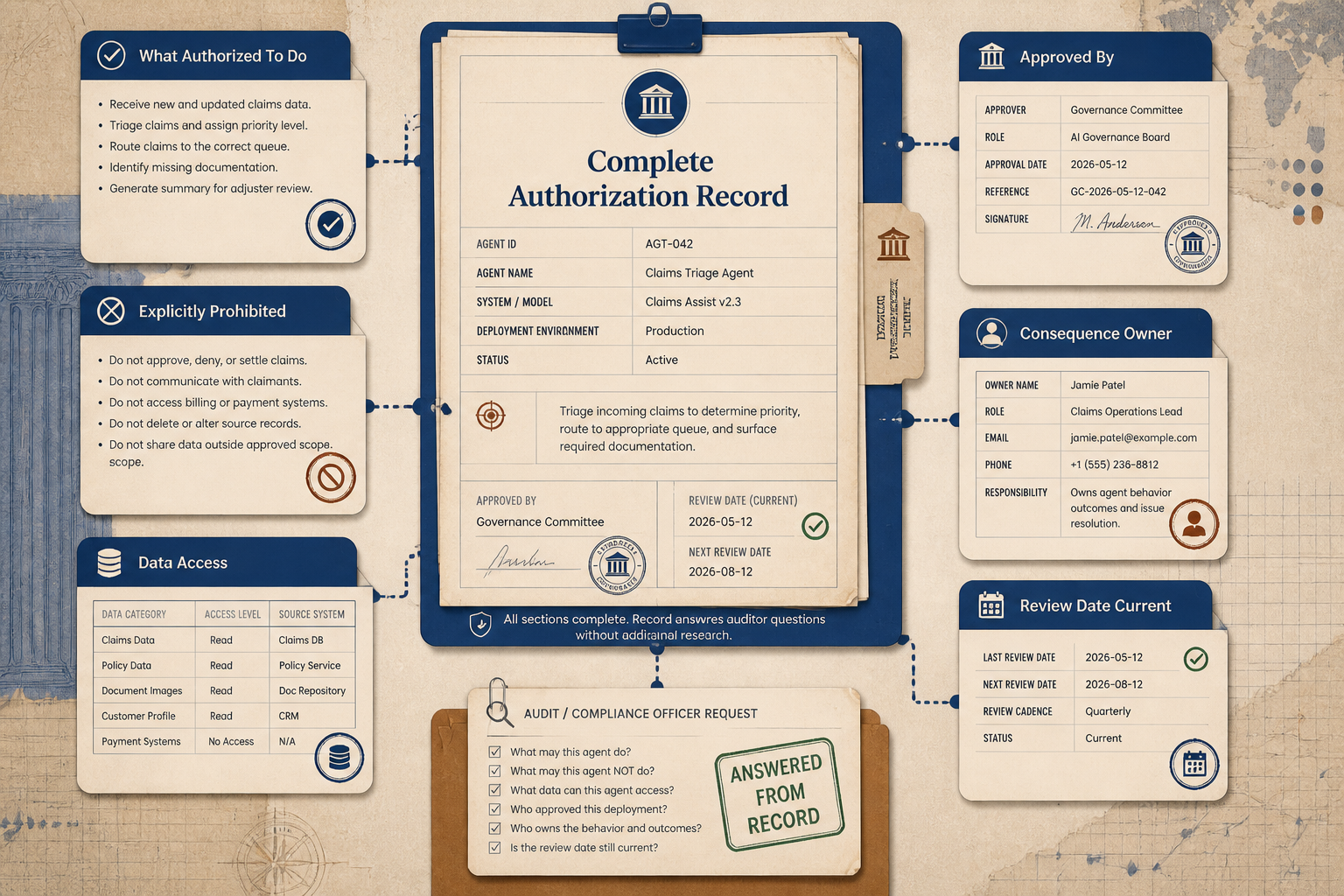
Complete record
A complete record can answer what the agent may do, may not do, what data it may access, who approved it, and who owns its behavior.
Any person in the organization, a new compliance officer, an external auditor, or a board member, can be handed the authorization record for any deployed agent and answer the following questions without additional research: what is this agent authorized to do, what is it explicitly prohibited from doing, what data can it access, who approved its deployment, and who is the Consequence Owner accountable for its ongoing behavior. The record is complete. The owner is reachable. The review date has not passed.
That is the standard. Most organizations are not there for most of their deployed agents. The Authorization Coverage Lifecycle measures exactly how far the gap is. Intent Architecture is the design work that closes it.