Back to newsletter
NEWSLETTER
The Day The Compliance Report Stopped Telling The Truth
June 16, 2026
NEWSLETTER
June 16, 2026
A governance toolkit can prove an agent followed its rule without proving the rule was ever reconfirmed under current accountability standards. In this edition, an AI accounts payable agent inherited its auto-approval threshold unchanged from a retired RPA bot, and the threshold was never reviewed when the AI agent went live. The missing artifact is the Agent Authorization Record, naming a Business Sponsor accountable for the rule, sitting between what Microsoft Entra Agent ID already defines and what the Agent Governance Toolkit already enforces.
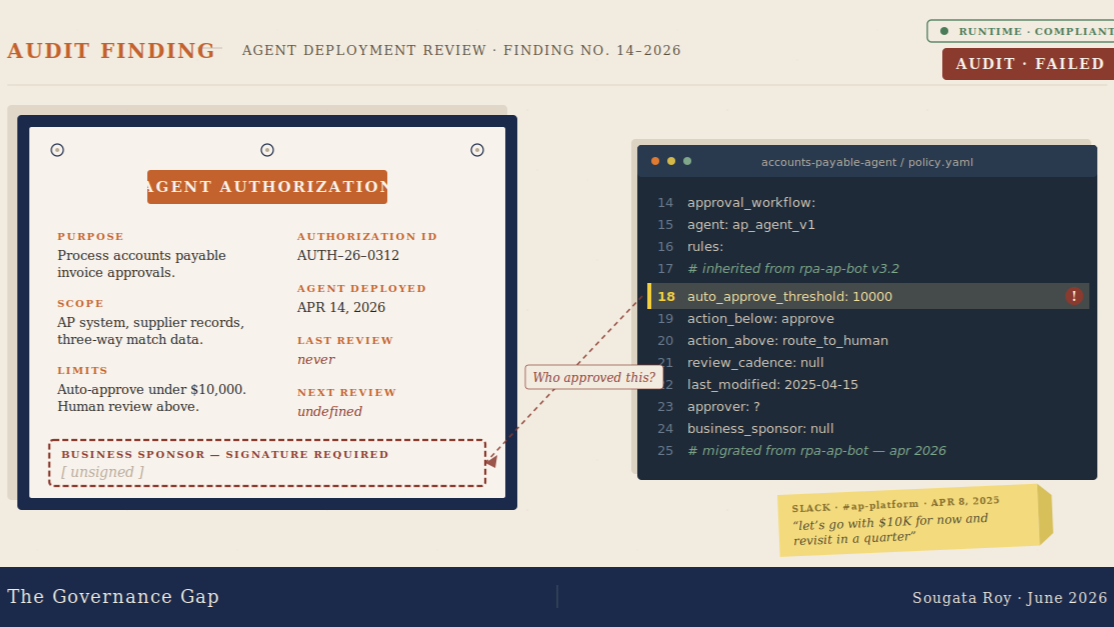
The accounts payable agent had been running for sixty days. It approved thirty to forty supplier invoices every day on its own. Anything above ten thousand dollars went to a human reviewer in finance. Microsoft's Agent Governance Toolkit was wrapped around it, checking every approval against a rule file the platform team had written before launch. The dashboards were green. The compliance report ran clean every morning.
The internal auditor showed up on a Tuesday. She watched the dashboard for about a minute. Then she asked one question.
Where is the record that approved the ten thousand dollar limit.
The architect pulled up the policy file. The auditor said, that is the rule the engine is enforcing. I am asking for the record that says someone in this organization decided ten thousand was the right number, that explains why it was not five thousand or fifty thousand, and that records when the decision was last reviewed against current fraud patterns and current invoice volume.
The architect did not have the record. Nobody in the room did.
The agent kept running while they looked for it.
The policy file was thirty lines of YAML. Line eighteen set the threshold at ten thousand. Above the line, human review. Below the line, the agent went ahead on its own. The architect went looking for whoever wrote line eighteen.
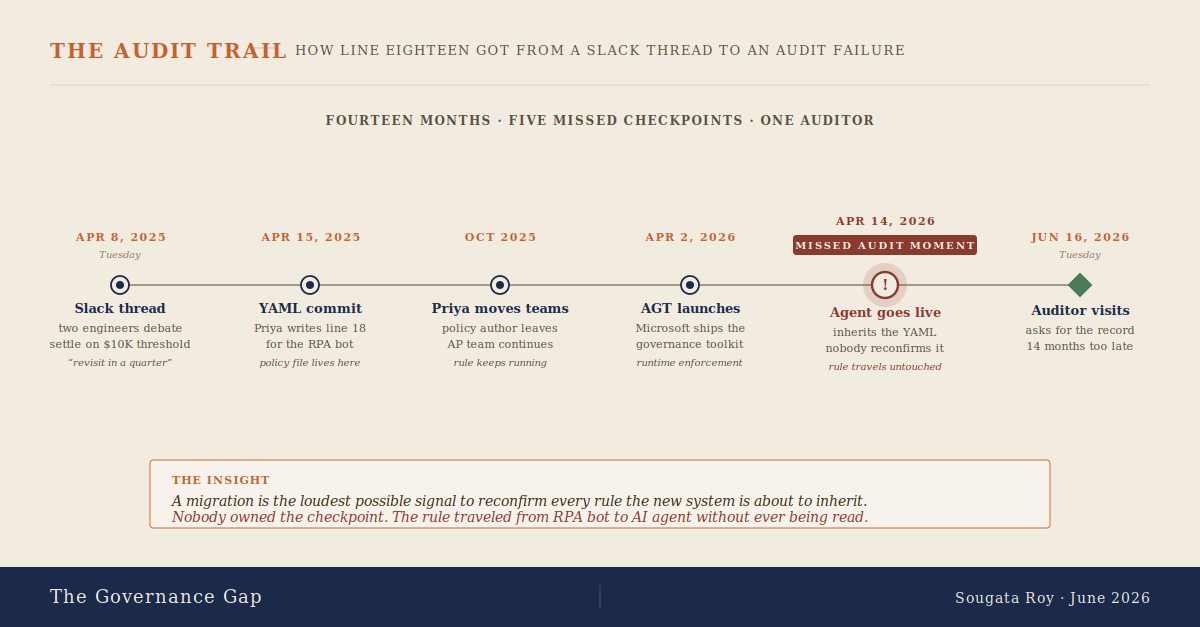
The commit history said it was a platform engineer named Priya. She had moved to a different team eight months earlier. He found a Slack thread from before her commit. Two engineers had debated five thousand versus ten thousand, settled on ten because five was going to drown the human reviewers, and agreed to revisit in a quarter. Nobody revisited.
The architect kept reading. The YAML file was older than the AI agent. It had been the policy config for an RPA bot that processed invoices in overnight batches, the same workflow the AI agent had been built to replace. The accounts payable team had run that bot for almost a year before retiring it in April.
That meant the threshold of ten thousand was already wrong before the agent existed. Fraud patterns had shifted during the back half of 2025. The supplier mix had moved. The RPA bot had been approving invoices under a stale number for months without anyone reviewing whether the number still belonged. Nobody on the AP team had asked the question because nobody on the AP team owned it. The rule was just there, doing its job, and the bot was just there, doing its job, and the green dashboards above both of them were just there, doing theirs.
Then the migration happened. The platform team built the AI agent. They pointed it at the policy file because that was where the rule had always lived. They wrapped the new Microsoft Agent Governance Toolkit around it because everyone knew AI needed governance. What they did not do, what nobody on the program ever explicitly assigned to anyone, was reconfirm the threshold under a new accountability model. The migration was the audit moment. The new system was about to make decisions continuously instead of in nightly batches. The volume was about to double. The visibility into individual decisions was about to drop. Every one of those changes was a reason to pull the threshold back into a room with the head of finance and ask whether it still made sense. Nobody pulled it. The rule traveled from the bot to the agent without ever being looked at, and the toolkit started enforcing it the moment the agent went live.
Then he ran the math.
Sixty days. Roughly thirty-five auto-approvals a day. About two thousand invoices approved by the agent on its own authority. He pulled the dollar amounts and sorted them. Just under three hundred of those invoices had been between six thousand and ten thousand dollars. Every single one had cleared the policy because line eighteen said anything under ten thousand could go through without a human looking. Every single one had a green checkmark in the audit trail.
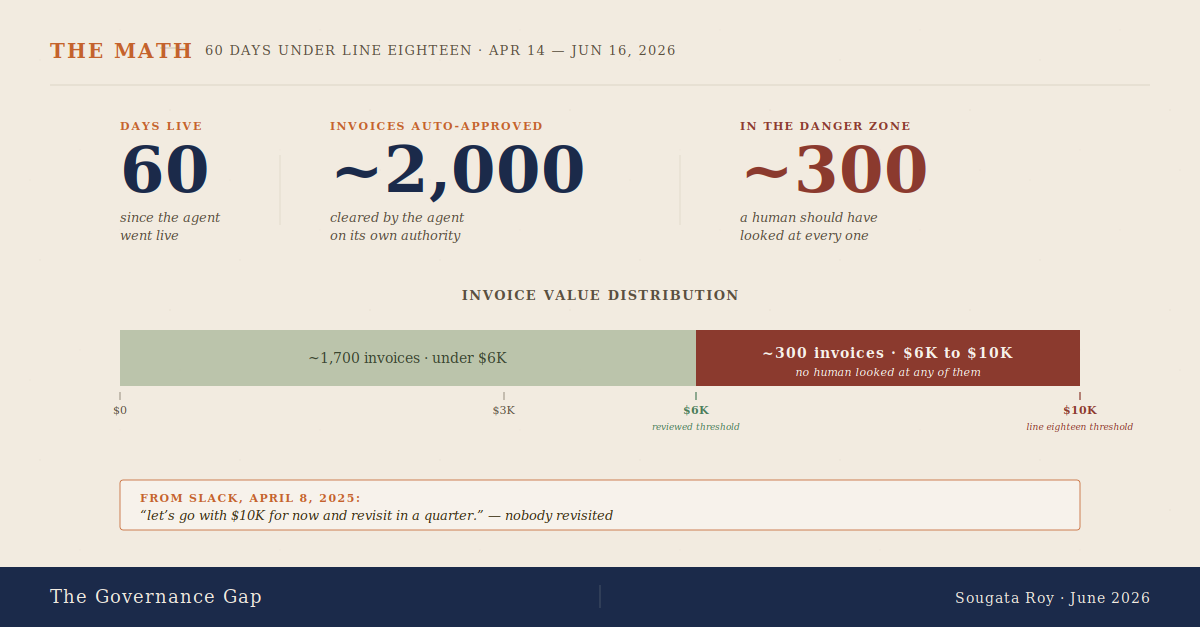
If anyone had reviewed the rule recently, the threshold would have come down to six thousand. Those three hundred invoices would have landed on a human reviewer's desk. A human would have looked at the supplier, the invoice, the pattern. Some would have been approved anyway. Some would have been held. Some would have surfaced fraud the agent had no idea it was looking at.
The architect could see how many had been paid. He could not see which ones should not have been. The human reviewers never saw those three hundred invoices. The agent had handled them all. The suppliers who received the money were not going to write back and say they got paid by mistake.
Nearly three hundred decisions that the organization would have wanted a human to see under today's risk tolerance had been made by a machine under a threshold written for a world that no longer existed.
The dashboard was still green.
That is the part nobody in the meeting wanted to say out loud. The agent was doing exactly what it was authorized to do, under a rule inherited from a system that no longer existed. The thing it was authorized to do was wrong, and it had been wrong for the entire two months the agent had been live, and there was nothing in any system anywhere in the company that would have noticed.
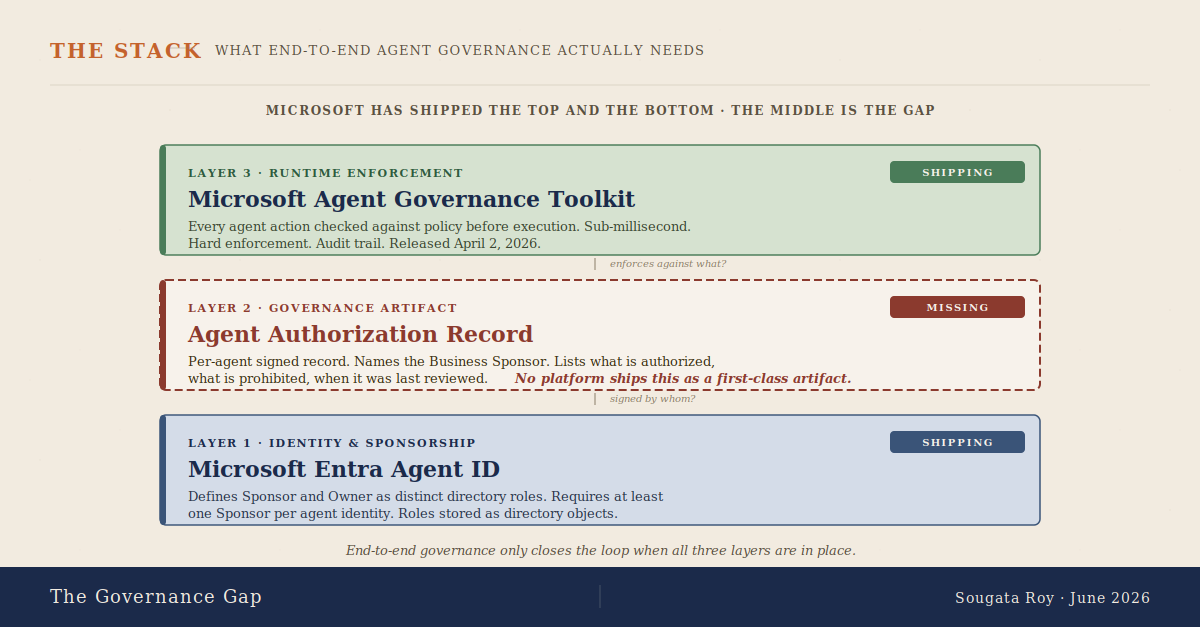
Microsoft released the Agent Governance Toolkit on April 2, 2026. The launch post by Imran Siddique, Principal Group Engineering Manager at Microsoft, is one of the more honest vendor announcements I have read in three years. The documentation puts it in two sentences. "Prompt-level safety is not a control surface. It is a polite request to a stochastic system." The toolkit responds with hard enforcement. Every agent action checked against a rule file before it runs. Sub-millisecond. Seven packages. Five languages. The engineering is real.
The governance layer could prove every action was compliant with line eighteen. It could not prove that line eighteen still reflected what the organization meant to do, or that it had ever been written for this system in the first place.
That is not a flaw in the toolkit. The toolkit was never designed to make that determination. The decision behind the rule is organizational. Technology cannot make that decision for you, although Microsoft is starting to talk about cryptographically proving who authorized what, which is a sign they understand the gap is real. Even that proof will still need a human decision behind it.
The artifact the auditor was asking for has a name. It is the Agent Authorization Record. One record per agent. It names the Business Sponsor who is accountable for the agent's purpose and lifecycle. It names the Technical Owner who is responsible for the operational side, and it is explicit that the Technical Owner is not the approving authority. It lists what the agent is authorized to do and what it is explicitly prohibited from doing. It names the systems and data the agent can reach. It records the events that should trigger a re-review, things like a change in business purpose, in data access, in ownership, in applicable regulation, or a security incident. The signature on the page belongs to the Business Sponsor. Not IT. Not the developer.
No agent platform ships this as a first-class artifact. Here is the part that deserves a fair hearing. Microsoft has done more than people give them credit for. Microsoft Entra Agent ID already defines Sponsor and Owner as distinct roles, requires at least one Sponsor per agent identity, and stores both as directory objects. Microsoft has shipped the roles. What Microsoft has not shipped is what an auditor or a board actually wants to see, which is a per-agent, human-readable record in business language that explains what the agent is authorized to do, why that scope was approved, when it was last reviewed, and whose signature sits behind it.
You only get end-to-end governance when all three work together. Entra Agent ID tightens identity hygiene. The toolkit hardens runtime behavior. The Record carries the organizational accountability. The three only close the loop together, and Microsoft is closer to closing it than most of the commentary gives them credit for. The missing piece is the artifact in the middle.
Most enterprises do not have that artifact because of what I have come to call the Accountability Assumption. The belief that the platform, or the vendor, or the team next door is keeping the record. Last year the belief was that Microsoft 365 was keeping it. The year before, it was the RPA platform. This year the belief is that the new toolkit is keeping it. Used alone, the toolkit can make the assumption stronger, because the dashboard is real engineering and the compliance report is a beautiful document, and a beautiful document signed by nobody can look exactly like a document signed by somebody until someone asks who signed it.
The gap that widened underneath all of this also has a name. The number ten thousand was set on a Tuesday over a year ago by two engineers who never came back to it. It carried into a system that replaced the one they wrote it for, without anyone asking whether it still belonged. The world changed. The agent did not. The distance between the organization's current risk appetite and the behaviors its agents are still performing under old decisions is the Intent Gap. It widens every week nobody is measuring it, and the audit trail does not catch it because the audit trail is recording compliance with the gap itself.
Writing the record closes the gap from this point on. The months already past stay open. The Intent Architecture Stack is the layer the record sits on. Layer 3 of the stack, the one that maintains organizational intent over time, is the layer almost no enterprise has built. Most teams installing the toolkit are sitting in stage one of the Authorization Coverage Lifecycle, which I call Unreconciled. They believe they are in stage three because the dashboard is green. The dashboard cannot tell them that the engineer who wrote line eighteen left eight months ago, that the system she wrote it for no longer exists, and that the world the rule was written in is gone.
The architect wrote the record the following week. The Business Sponsor turned out to be the head of finance, who should have signed when the AI agent first went live, who should have been asked when the RPA bot was retired, who had not been consulted on either occasion. He walked her through the original logic. She reviewed it against the current fraud trends and the current supplier mix. The threshold came down to seven thousand. She named the prohibitions the original record had never written down. She named the events that should trigger the next review. She signed the page. The architect's name went on the Technical Owner line, which is what should have been there from day one.
What the record could not do was undo the previous sixty days. The invoices that had cleared between seven and ten thousand were already paid. The suppliers had already received the payments. Nothing in any system could tell the architect or the auditor or the board which of those invoices the company would not have approved if a human had been looking.
The agent was the same agent the day before and the day after. What had happened in between was what nobody could reconcile with what the organization now believed it should have approved.
In almost every environment I see right now, there is at least one agent running on a number that started as a Slack message somebody never came back to. The number outlasted the system it was written for. The toolkit will not find it. The dashboard will not name it. The number is approving things the organization may not approve of anymore, and the audit trail you trust is recording every one of them as compliant.
The harder question is how many months of agent decisions you will have to explain before you write the record for every one of yours already running.