Back to newsletter
NEWSLETTER
You Cannot Fire the Agent. You Already Fired Everyone Who Was Doing Its Work in the First Place.
September 15, 2026
NEWSLETTER
September 15, 2026
The claim that an agent can always be turned off depends on having people who could do the same work at scale without it. Once the headcount saving is taken, every future reason to suspend the agent, such as a regulator inquiry, a security finding, or an audit, carries the price of rehiring staff. The line in the automation business case about the people who will not be replaced is the decommissioning plan, and the authority to act on it sits with whoever controls the staffing budget.

The meeting occurs on a Thursday. It is a constructed corporate scenario, but you have sat in a version of it. The automated agent handling initial customer contact has been operating for nineteen months. A regulator has asked a question about how the system explains a particular fee. The legal department wants to immediately suspend the agent. This step would stop the agent from providing the same explanation to other customers while the company conducts an investigation. The CIO repeats the statement everyone has used since the original business case: we can always turn it off.
The head of operations computes the figures out loud. The agent handles two-thirds of all contacts. The team previously responsible for this work comprised forty people. That team now includes eleven members, with six of them working on the escalation queue that the agent feeds. If the agent is deactivated on Friday, Monday's contact volume will fall on eleven people. These employees have not handled first-line contacts for about eighteen months, if they ever did. Deactivating the agent for one month would necessitate hiring new staff. Hiring would require approval, which would require a headcount request that reverses the cost savings the CIO reported to the board eighteen months ago. The CIO personally presented those savings, under his own name, with a slide stating that the agent was working.
The agent is working. That is the issue. Nobody in the room is deciding whether to deactivate it. They are assessing whether the company can afford to have a reason to do so.
That mechanism is on public record. Recruitment for all non-engineering roles at Klarna stopped in December 2023. Some of that labor was replaced by AI, Klarna said. By February 2024, Klarna said its AI assistant performed work equivalent to that of 700 full-time agents. Staff numbers were down 22 percent (to 3,500 people in total) in December 2024 mostly due to attrition. Instead of hiring to recover this loss, the remaining people were told by their CEO they would share in the productivity gains AI brought. This seemed to be a real saving, that was public and attributed to use of an AI agent by their company.
Klarna started hiring all these human customer support people again. Siemiatkowski had looked more at the cost side when assembling such a department and its quality diminished. He told Bloomberg that it is important that a customer has the option to be able to talk to a person than an AI. Bloomberg, May 8, 2025. It will replace its outsourcing agents he says, which number a few thousand at this point. In the SXSW London one month later, he says two things are true at once. The AI delivered on expectations from the cost point of view by increasing revenue per employee he suggests. The human call center, on the other hand, should provide a more special service and become something close to VIP access.
Look once more at that second sequence of events and what is noticeable by its absence. Klarna did not say they were technically incapable of turning it off. They did not turn it off. Instead, they kept the AI, rebuilt - or are busy rebuilding - a human layer around it by hiring staff, spinning its position in the market as one thing and replacing their existing staff by defining its roles differently, so that the AI remains untouched. But the mechanism for removal has been there the whole time. What drained through 2024 was the capacity, one departure at a time.

Klarna may not have been wrong about its maths backing the reasoning why it had acted this way. The question lies with the word always, as in "we can always turn it off." It never spoke of turning off the agent but the fact that it had people on board that could provide this capacity of work at scale without the agent. This word no longer held once the cuts were made. Nobody corrected it because nothing wrong had happened yet.
Every organization that uses their agent at scale will have made this trade, even if it is not documented. It was the same person counting heads as the person evaluating risks. The person that caused the team reduction also decided which reasons to suspend the agent in the future could no longer be acted on, like a regulator inquiry, a bad quarter of complaints, security finding, vendor dispute or an audit. Every single reason now comes with the price of rehiring staff and it is the same person responsible for budget allocation getting asked to spend that money because at some point, the same reason that the company reduced the number of employees for a low price, will now require restoring that number at a much higher price.
Now, back in the room Thursday next week and the issue is: how long would that agent be turned off and at what volume and most of all, who has the final say on hiring enough people to fill the gap before you switch it on again. The staffing authority has belonged to finance instead of the security department since the day that saving appeared.
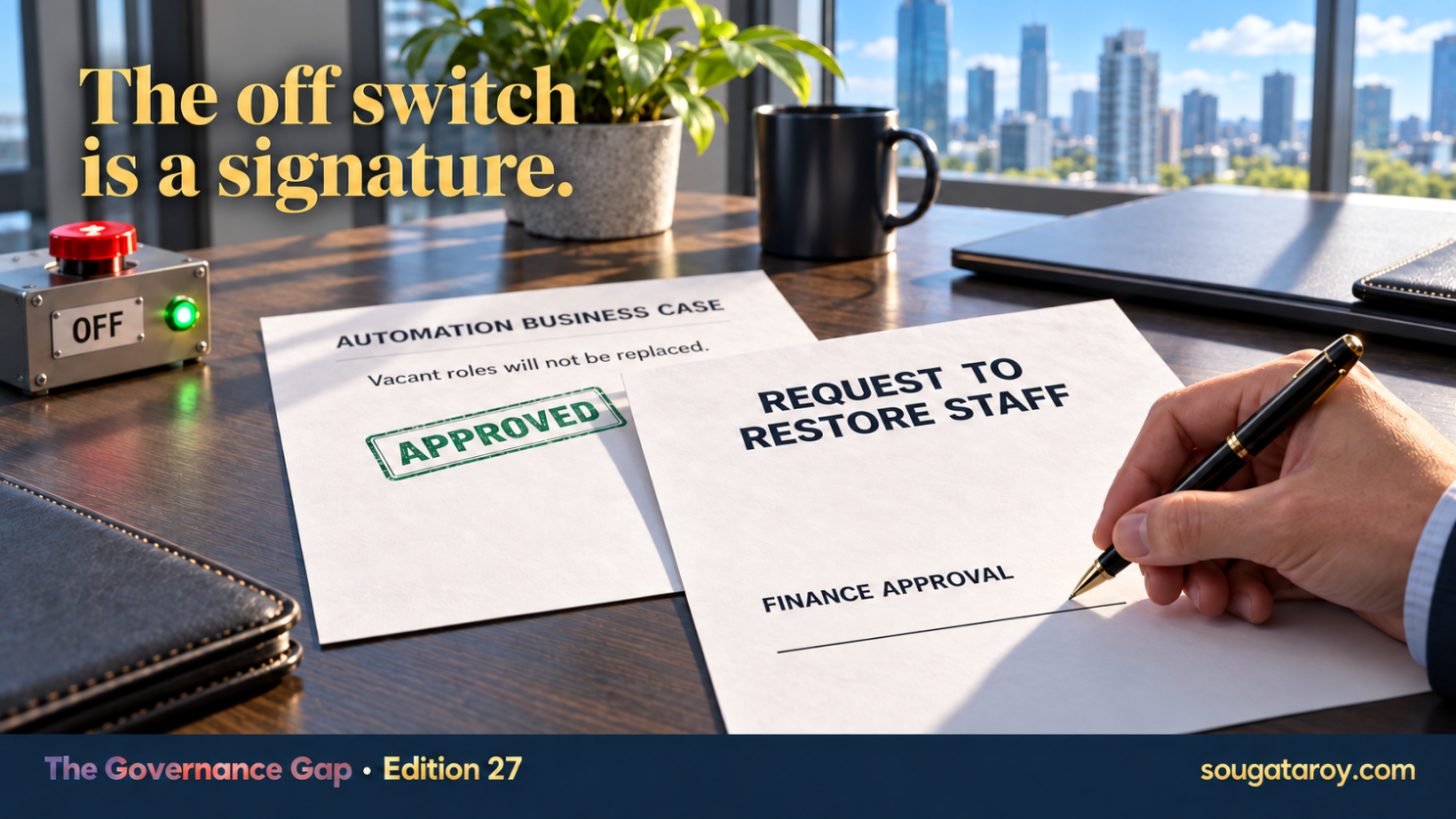
Find the recent automation business case that your firm approved. Somewhere in it is a line about the people who will not be replaced. That same line was the decommissioning plan. The person who signed it off decided which risks the firm will have to live with without being asked. Find out whether that person knows it.
The opening scene is constructed. Every statement about Klarna is drawn from the linked reporting of the dates shown.