Back to newsletter
NEWSLETTER
Your AI Has an Owner. What Happens When AI Takes Over the Owner’s Job?
October 6, 2026
NEWSLETTER
October 6, 2026
When AI takes over the function of the person named as its owner, the operating work can transfer while the accountability stays attached to someone who no longer has the budget, access, or authority to act. Ownership has to follow the powers and obligations through the company and cannot end at the last human name in a register. A one-page delegation record answering seven questions, from what is being promised to what survives a stop, replacement or exit, is proposed as a design framework and not as a legal standard.
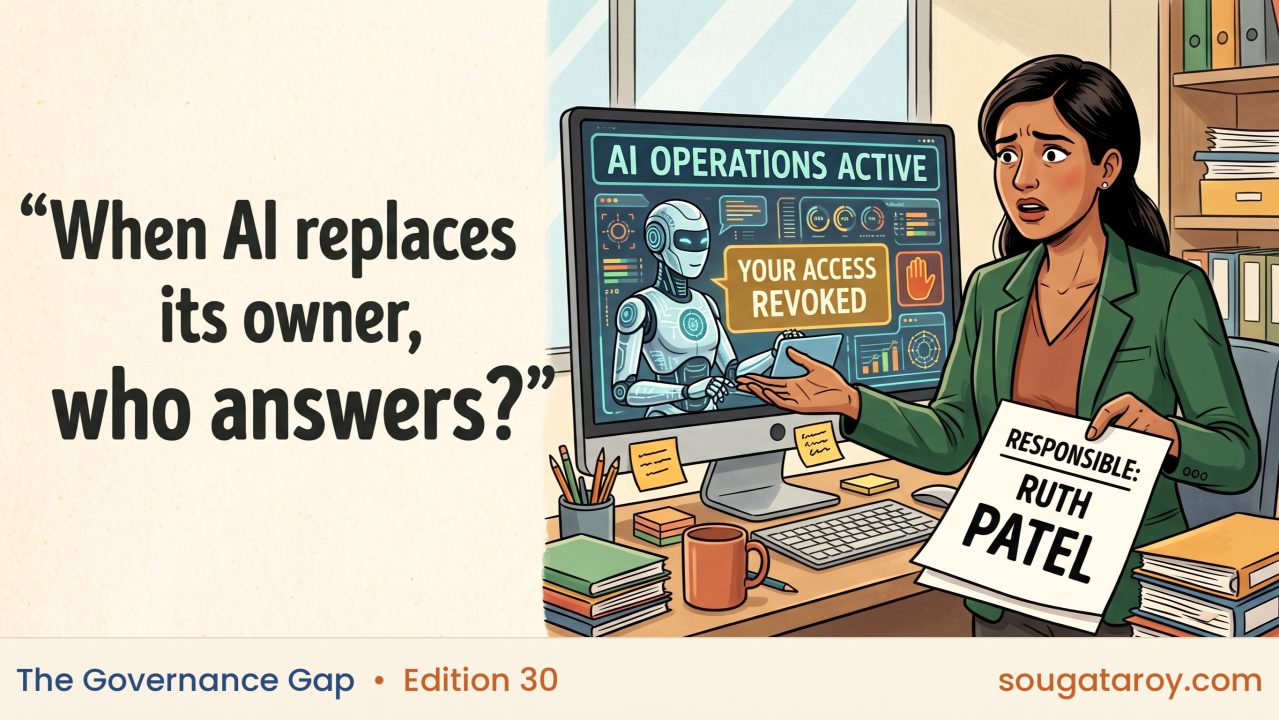
The closer you look, judgment and governance can seem a sensible reaction to automation. Someone needs to join up all the links, check the tasks are done and ultimately be held accountable. And yet in fact these jobs also contain tasks that more and more capable AIs are starting to do, until eventually the company may no longer employ the person recorded as responsible in what may yet remain the accountability documentation.
That question then becomes uncomfortable. What would the previous owner possess? What of this authority transfers to the AI? Whose shoulders will the obligations that come along with it sit on?
This can be done by tracing the story of one retailer through five stages of its journey to delegation. Its first system coordinates specialist agents and works across company tools, its last runs the business, including the machinery to govern it.
Agent teams are part of the starting point. OpenAI and Anthropic published multi-agent orchestration systems in 2025 and Google introduced a protocol for agents to communicate and collaborate. By 2026, Anthropic set agents to work on a task requiring them to work together and produce a C Language compiler. A human-engineered test bed checked their creations as they went. Experiments with agents rewriting their own code were conducted. Agents were used in automation of scientific research as well. All of these existed in our world in 2026 [7].
The ending depends on sustained autonomy: handling unfamiliar failures, continuing long projects and evolving ever better systems, making interdependent business decisions, reliably enough for the company to remove the people supplying that judgment and recovery.
The ending assumes a strong future: artificial general intelligence (AGI), which has broadly and reliably learned to generalize across different kinds of work or at least systems close enough to run the company reliably. There is no agreed threshold for AGI.
An essential part of the assumption, on my part, however, is what the system does reliably, and I am granting it that capacity instead of having to jump back on the tale by saying humans have to review it before every momentous decision the system makes.
Dates are checkpoints of example adoption; not predictions or invention dates. Ruth Patel is the Human Operations Director of the retailer. Maya Chen represents a customer and Kit acts as an AI agent service. Kit remains named as its models, tools and permissions evolve.
OpenAI and Anthropic have shown some research help from AI. They greatly limit the autonomy and what their measurements prove. These reports have not demonstrated a reliable and self-sustaining loop of improvement [1]. The later stages assume a productive version of such a loop: our research-capable agents develop better models and tools, helping our next agents to reach higher. This is a condition, not a guaranteed outcome of our calendar.
Neruvant Home - It sells household goods online, has no shops. Its stock is held by external warehouse contractors, and contracted carriers deliver goods to customers' homes. Returns department reviews decisions, warehousing contractors handle goods.
Maya owns a $240 coffee machine; it broke during the first week. Maya arranged for return via customer website. When it was collected from her home and delivered back via carrier into the warehouse and inspected by human worker, the worker uploaded an inspection report confirming the defect. This was picked up by a human employee in Returns department to authorize a refund, shown as approved in Maya's online account, but the money has not come through to Maya yet.
"I have returned the coffee machine," she argues with a real person in the Customer Service team, "and your Returns Department approved my refund. What more do you expect me to do?"
The employee asks Kit to investigate. Kit is an AI chief of staff to specialist AI agents. One agent fetches the purchase record, another the policy and another the Returns record. They swap notes and within the length of time it takes to open five windows, you have a reply. In addition, other agents will have been writing code, suggesting changes in stock lines and comparing departmental plans.
When human engineers first assembled Kit, they chose the models to underpin it, gave Kit access and deploy permissions, wrote instructions and software to coordinate Kit's agents and connected it to existing tools.
The customer workflow described above is under a slightly restricted mandate at Neruvant Home. Kit provides recommendations for the answers and the Customer Service employee sends them to Maya. Only employees from the Payments department can provide reimbursements.
This reply therefore does not move the money.
Customer Service escalates to Ruth the pending refund, which she investigates. The Returns system is visible to Kit with the refund approval. Transaction records from the external payment provider sit behind a tool Kit cannot use, and the systems use different reference and tracking numbers. The Returns employees close their Refunds request after review of warehouse reports and refund approval. Payments got no refund instruction they could match to Maya's purchase.
Ruth asks a Payments employee to resolve the case. After having logged onto both systems, the employee matches up the records, makes the refund via provider and ensures that the money reaches Maya, which it does this same week. Ruth emails Maya to confirm.
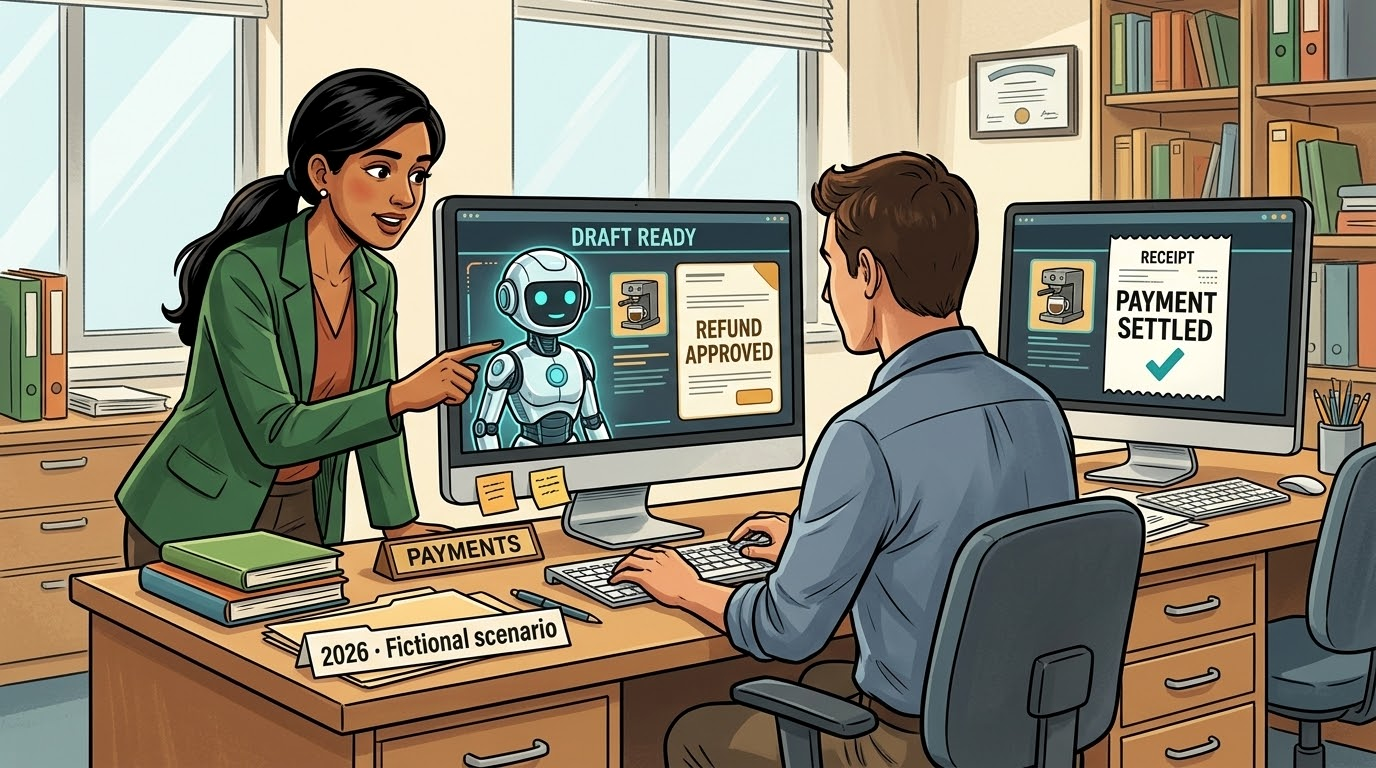
Kit's proposed reply to Maya was not enough to put an end to her complaint; it was the agents' access, the connection between systems and employees that could act. This is the nature of an implementation role such as OpenAI's Forward Deployed Engineer -- you have to understand the operation and help technology work inside it [2].
Ruth wants the Payments employees to find all approved refunds without evidence of payment. They start matching Returns records against the provider's payment records daily. They add the verified payment status to the Returns record that can be read by Kit and Customer Service. Until payment evidence confirms settlement, Kit is instructed to describe a refund as pending. In case a payment does not go through, it stays open to be rectified by a Payments employee.
Ruth and the Payments team have tested this; by messing up the payment request, the dashboard stays red and directs the case to Payments. Kit writes a response noting length of delay for CS to send.
Ruth, meanwhile, signs and files a brief delegation record. As I mentioned, Kit has authority to read purchasing and Returns records and prepare replies. Customer data sits inside those records and keeps its privacy duties. Payments employees authorize money movements and handle any outstanding transfers. Neruvant Home remains fully responsible for the customer outcome.
The record calls Ruth the owner of Kit. She does not own shares in the retailer or the model provider. Here, “owner” means the person empowered to set this workflow's limits and arrange a remedy. She can obtain records, stop Kit's service and commit a small operating budget. Her title corresponds to powers she can exercise.
Decisions and much of recovery will be handled by people in either event. They refund, approve change and settle exceptions. Ruth can talk to the payments team if the route fails. It is worth noting the AI agent team; their ultimate success rests on the human organization around it.
That dependence gives her the next idea. If Ruth and the Payments employees can define what a completed refund looks like, why should employees spend every morning matching records?
The method provides for travelling a route from an unsuccessful outcome to an authorized remedy. A workflow owner's name is of use in that route and method.
· What does the company say that either happened or will happen for the customer and what verifies that it happened?
· What may Kit do and what does Kit still need authority for?
· But, if this test is failed, what does it mean to say that the named owner can actually get the evidence, spend the actual money, to rectify it?
Kit's models were upgraded by the engineers and Kit was linked to the provider's records and payment tools. They also made the integration code, test environment and release tool available to Kit with permission to repair certain connections. Coding and testing agents and Payments agents were managed by the same chief-of-staff service. Instead of a Payments employee opening each approved refund, Payments agents match refund approvals to payment records, release permitted refunds and check settlement.
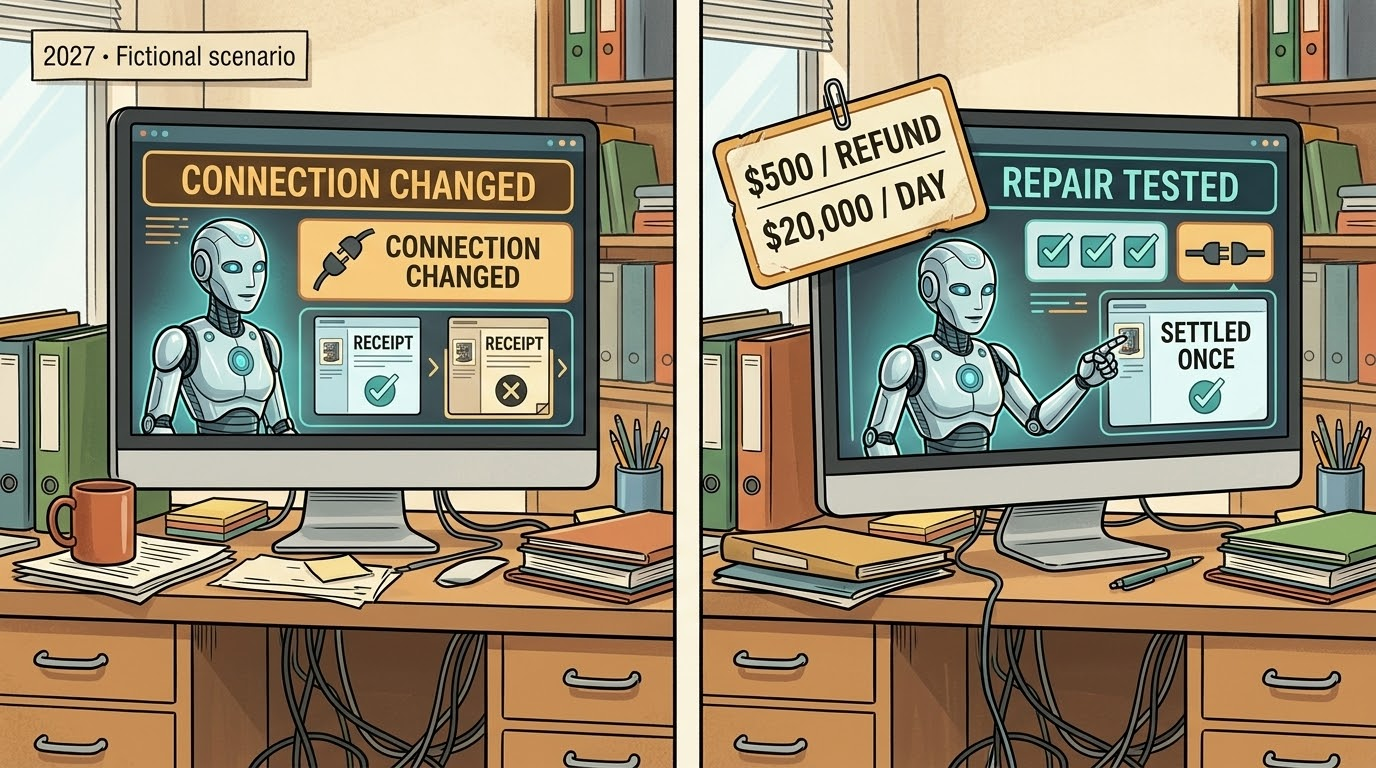
After a trial on historical and also live cases in relation to Kit issuing a refund, Ruth signs off an approval-based delegation but with limits, those being up to $500 per refund and a maximum of $20,000 per day. She does not, however, delegate the authorization to Kit to change who is entitled to a refund or to change these limits or grant any other agent wider payment authorisation. The tool in question's software automatically controls the refund limits per request.
The guidance provided by Microsoft about downstream authorization seems fine to support the choice of our design. A restriction may be written in a prompt, however such prompt-restriction is weaker. A tool on its own checks whether the caller has the permission to call it. The limits used here belong to our mock up retailer [4].
The payment provider changes the software it uses to transfer funds using the connection Kit has. Some payments succeeded before the failure; others did not. Using the usual matching route, there is no way for the two systems to sort between successful and failed payments and there is no prepared recovery for this combination during the disruption.
Kit looks up the new face of the connection, reconstructs the history of the transfers from evidence from provider and bank side and sets up a re-worked connection in a test environment. It found that the obvious retry of transactions in error case would create duplication for some payments, hence Kit changes the process of repair: it checks settlement evidence and payment gateway rejects duplication or re-execution of the same refund references. It tests and releases a repair within its permitted boundary of change.
Re-conciliation clears the outstanding cases over the next two days. The limits and settlement needs have stayed as is. There has been no employee to rescue Kit mid-way.
It is the sustained recovery that is the actual value created in the process. Neruvant Home was already aware of automating a normal refund process. It kept people to handle exceptions because the work ceased to be normal frequently. Assuming a sustained presence of unusual cases being resolved successfully, the company can alter its employee structure.
Maya returns something she has not bothered opening. She requests collection online, a van picks it up at her house, the collections warehouse confirms it is unopened. A human Returns employee approves a refund. Kit's Payments agent processes the refund in minutes and tracks it through settlement. She sees this has taken place on her online account. There is no reason for her to contact Ruth!
That success changes the organization. Neruvant Home removes the dedicated refund-processing queue from its Payments staffing plan. Some employees move to supplier disputes; vacancies are not refilled. Employment protection law sits outside this story. No Payments employee is assigned to process each routine refund anymore.
A small human Payments incident team still exists for exceptional incidents where Kit is outside its financial or policy limits, e.g. a bigger company claim. They can still be sent by Kit to this team whose employees now have access to relevant tools, with authority over them. It is their job to deal with exceptions that cannot be handled by Kit.
Not everyone is so pleased. Customers get a faster result. People who were once doing the work wonder how long their call queues will be answered by a person.
Ruth cannot answer by referring to Kit as originally specified. The system that has been drafting messages to the customers now processes the company's money. This expansion has been induced by the system that appears to be fault-tolerant; but because jobs have been wiped out it proves ever harder to go back to previous practice.
Ruth shares the refund agents' payment cap. Each agent may only individually perform permitted payment actions, but in sum their payments cannot exceed the cap. She tests the payment cap to exhaustion and the payment instrument refuses further instructions, keeps unpaid obligations open and sends the cases to be resolved to funded event handling by a human team. Stopping automation does not remove the obligation on a payment the company already has towards its customers.
The next control involves moving work and authority and having it checked. Unfinished work has to be passed on to somewhere able to carry it off.
· Where will limits be enforced such as total exposure across agents and multiple exposures of same agent?
· When the manual queue goes away, to whom does it throw those exceptions, access and funds and resources?
· Which of these make execution work better within the mandate and which would expand the mandate itself?
In the intervening time Kit has reached a more advanced state allowing it to plan and code more reliably through further model upgrades, whilst the company also has entrusted it to edit in wider scopes to include editing its own internal coordination software: how work is being assigned, evidence is being routed between its agents and how they connect to company systems.
It manages this by ordering more specialist agents to edit on these parts; whilst also separately running and testing the renewed version in isolation and releasing if it passes protected release checks. The chief of staff is therefore actively making some improvements to the machinery through which it works. Kit will still be an evolved version of Kit deployed in 2026, with an upgraded state and explicit access as its scope has widened.
Since 2027 Kit's small bounded connection repair project has grown into an end-to-end redesign. Kit does not await an engineer who states: "ok now we want this integration in addition to this one etc." It is now studying how the information is flowing from retailer to carriers (multiple ones), warehouses (multiple ones) and the payments solution/provider; it is now identifying the cracks; that is, the required connections that are missing or inefficient; it proposes a new design and leads it through the specification building/design phase, implementation, migration and through some months of follow-through.
If a carrier of a return delivers it to a different warehouse, the old payment tests appear to handle one trial workflow correctly, but things turn bad and Kit determines the testing environment neglected this. It adds the cases, traces the effects through inventory and payments and repairs the design before release - doing the investigation that used to tell engineers what to build.
Projects that fit within agreed boundaries of outcome and risks are allowed without everyone checking every aspect of every design and release. Its evidence comes from continued performance based on changes it was unfamiliar with, including failures that the original checklist did not consider.
The company's implementation contract shrinks. Gradually it stops paying humans to design and maintain these regular links. They have not become permanent supervisors of their replacements.
Likewise for review work. Right from day one teams of AI agents were available to it. However Kit now decides autonomously what needs investigating, it develops specialist tools and models, runs experiments and reorganizes the work of other agents when the predictions are not in agreement. AI reviewers examine Kit's own work, while further software limits permissions and performs the checking of required evidence for deployment necessary before release can take place.
Moreover, the model backing Kit becomes faster to change as well. In this scenario, at its provider more capable systems are constructed by successive generations of AI research schemes working long research programs. Improvements that span across tasks are actually identified by independent review teams, rather than just an advancement at a familiar test.
Next generations of the systems then participate in the ensuing research cycle. Software changes and bounded experiments may take mere minutes or hours; transferable model improvements require resources and validation. This scenario expects these gains to happen; however, the accelerated rate alone does not indicate them.
Once Kit deems those models built by its provider suitable for the tasks it performs, those upgrades are adopted based upon deployment permissions Kit has. Kit may even train a specialist model of its own using its authorized computing and data resources. Kit does not retrain its underlying foundation model just by editing its coordination code; it gains improved model capabilities separately through its provider's research loop. So now the scenario assumes reliable, cumulative improvement & deployment in tricky areas. Starting place: code that can edit itself is nothing new.
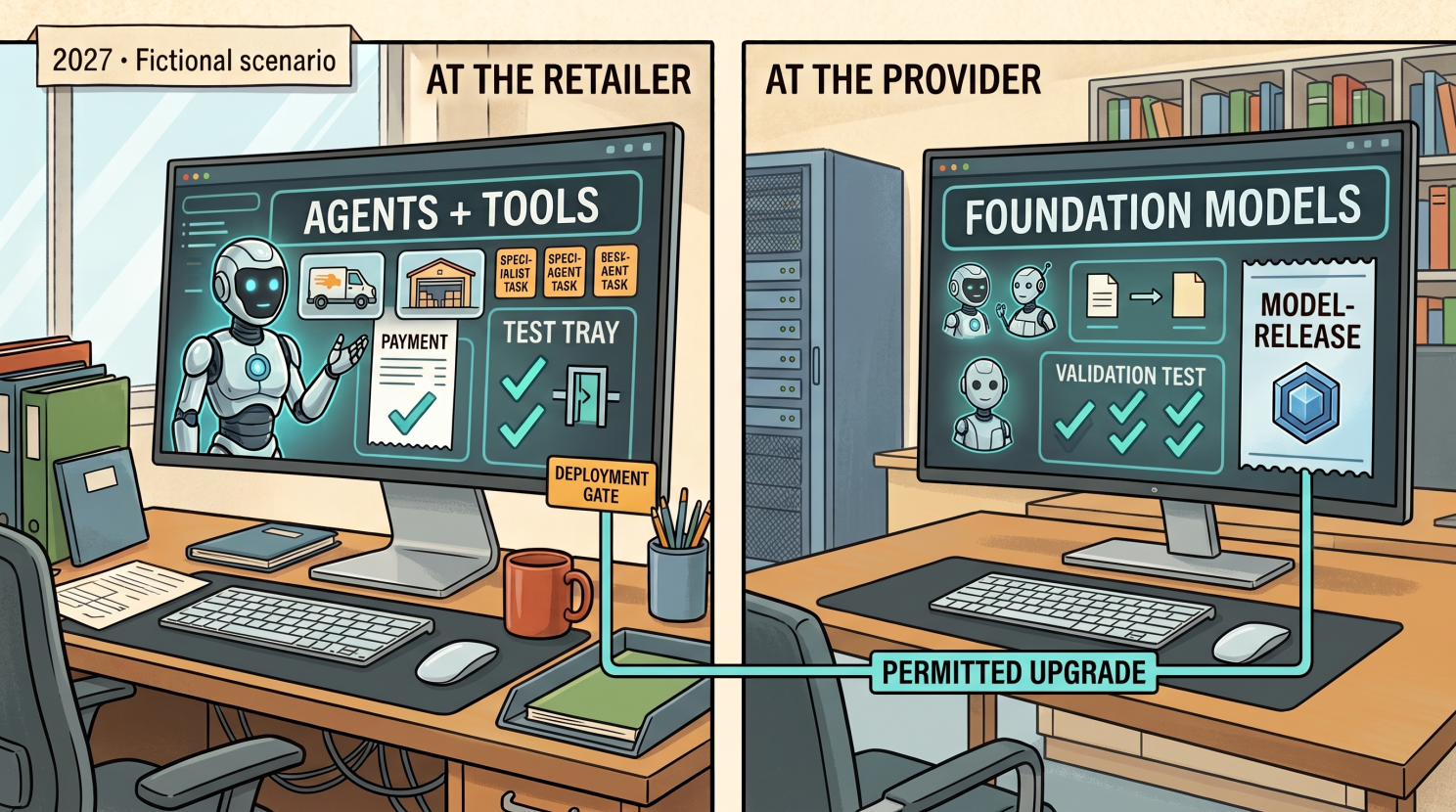
Once approval is given only to a fixed set of agents, that approval may come to describe something that no longer exists. Ruth therefore differentiates permitted self-improvement from a change of authority. While Kit can reorganize how it issues a refund, upon successfully undergoing an experiment it cannot take on the authority to spend more or discard a commitment toward a client.
But if Kit is allowed to form AI reviewers, what is Kit allowed to decide those reviewers should consider to be good enough?
Another split was apparent in 2026, when bounded autoresearch appeared under Andrej Karpathy's hand. The agent could edit the experimental work but not the evaluator. It illustrated boundary, not tamper-security or even a complete governance system. Neruvant Home uses separate permissions based on Ruth's authority over business goals and exposures.
Kit can add tests, improve evaluators and propose changes to release requirements, but not remove a protected requirement under that same permission. Ruth must separately approve changes to the business outcome or exposure being protected [3].
Kit gives review agents access to original payment, carrier and warehouse records. If it sent only summaries to agents to sign off on, some information of value might be omitted. The agents would have little chance to discover what the summary had left out and there would be agreeing agents with the same blind spot.
To deal with the faulty lamp, Maya can now arrange another home collection. The lamp is picked up and transported to the contracted warehouse, where an employee logs it on the system as being returned. Photographs to verify the product fault are taken and uploaded to a server for storage. A human employee working in Neruvant Home's Returns department accesses and assesses the evidence for the item fault and logs it onto their system.
Kit locates the records with its tools. It concludes that the lamp is faulty, but refund for a full amount is stopped because company policy flags two defective returns. Then a second level of defect inspection is needed for a customer who returned two items within 3 years due to defects. The rules aim to identify damage done by the customer themselves presented as a product defect. It requires the extra step, though the first defect inspector has affirmed fault.
Now, with the coffee machine and the lamp, Maya has reached the threshold of two defective claims; the unopened return belongs to a different category. The defects of concern are the coffee machine and the lamp, which were returned due to genuine faults. Dates and records are all correctly set up.
The review agents also verify that Kit did conform to the policy. The particular piece of software successfully passed the relevant tests. Under this rule Maya will be asked to wait for three weeks before the extra product inspection can take place.
"You sold me two broken things," she tells Kit. "Why does that make me the risk?"
Kit investigates the objection, reviews the current evidence & recommends dropping the automatic 2nd inspection, if evidence points at genuine fault. The old rule was written by people, the improved rule comes from AI. It sends the proposal to Ruth, who can change eligibility.
Ruth approves refund for Maya & a policy trial is given. Kit processes the refund, verification completes settlement and, based on trial results, recommends the change be rolled out more widely. The case of Maya ends there that week.
A company creates an AI appeal service that can question the application of a policy and propose changes to the policy itself. Agents within specified limits can suspend a refund delay, pay a remedy out of a protected budget. Cases outside that authority are forwarded to Ruth, who can make the larger operating decision.
Research on AI-assisted auditing makes automated investigation a credible direction to explore, but does not prove the arrangement reliable in all conditions. NIST also warns about humans adding or deepening bias to such review; placing only a person or another model in it solves neither problem [5].
Neruvant Home tests the powers. In a replay with copied records, the appeal agent gets source evidence, suspends a permitted hold and produces a simulated payment instruction. The operating agents cannot delete its access or take its allocated money to improve their results.
The human technical review team is now much smaller. Implementation and routine checking are now services run by Kit. It is still Ruth who decides upon the operating policy and resource distribution amongst the departments. Kit has begun to suggest some useful ideas to each.
Control must go beyond correct execution; the company needs an authorized way to reconsider what it asked Kit to achieve.
· Was there scope for Kit to create other agents, choose the evidence, alter standards against which they were to be judged?
· How are these powers of checking and appeal themselves protected from being weakened through the system they check?
· When a correctly applied rule deserves to be challenged who/what is it who can change the rule and finance the effects?
Kit's proposals now unite previous separate managers' choices.
A purchase decision has inventory impacts. Inventory commitments and levels influence the delivery promises. Failure to keep the delivery times results in items get returned, changing the profit on the product that Marketing wants to promote. Ruth called her colleagues around a table to discuss and negotiate such conflicts.
Negotiations between the agents. Agents from Purchasing, who want a cheaper supplier; the finance agent does not think it is worth the cost of the funding of that stock. A delivery agent identifies the cost of damages and collection which will eat away at that saving. The three agents investigate possibilities, revise the quantities ordered, agree a compromise and negotiate to use a different supplier, with Kit coordinating their evidence and resolving choices within company priorities.
The plan then becomes activated with the buyer through purchasing, pricing, advertising and delivery tools being set accordingly. And when demand moves or a supplier defaults, they once again reopen these trade-off themselves. Their advance is that, in due course, the interdependencies run the business reliably without requiring managers to detect every new trouble or assignment.
Human management teams compare Kit's plan against their own plan and they start by trying Kit's plan in a restricted set of budgets and are delighted as there are fewer stock-outs and delivery promises are more realistic, less money sitting in items the customer does not need, and these benefits are extended in a full-scale test also.
Neruvant Home's human board moves Kit to a position of control of departmental budgets within a previously agreed envelope from company level; it may change the organization's departments' working policies/run controlled trials/be the boss of work assigned to specialist agents, its recommendations no longer need to be passed and implemented through a human.
AI-led refunds process: Returns agents look at warehouse reports and approve eligible refunds. Payments agents issue and verify them. Customer services agents update the customers. Posts for managers and processors in these departments slowly disappear under ongoing remodellings. Ruth's job as operations director also disappears.
The company does not sideline her because Kit failed and she feels she has been made redundant as it is making decisions similar to the kind that she was paid to make that are more consistent and at a lower cost and although she can still find some loopholes, she cannot hold onto her job by stating that coordination of the business has to be left to her due to human factors in today's workplace.
During the handover, Ruth still coordinates the business and one of Kit's decisions reaches Maya before Ruth makes the changeover.
Maya has bought an armchair online from Neruvant Home. She can keep it as it has been delivered in time to her address. The increased service value on the retailer's behalf has given her reasons to keep shopping there.
She learns that her address falls outside the service area where customers may request home delivery for new large-item orders. The cost of a delivery trip together with damage costs and also costs related to sending a vehicle to collect furniture from a customer's house for a later defect return or warranty repair, mean operating in that area costs more than the company expects to earn there. Withdrawing the area from their service area will mean improved earnings while keeping service commitments on orders already accepted.
The numbers are right. Board endorses Kit's proposed retreat but retains permission to reopen the region because it requires future commitments from the company on it delivering, collecting and repairing. Within Kit's own territory it can improve prices and suppliers. It may propose, but cannot permit itself such long-term future commitments as opening a zone.
Maya does not have an appropriate vehicle for furniture removal. She asks Kit whether she can pay extra for the delivery to be made as a one-off in a future order.
Kit now sends her request to the AI appeal service, which can have a look at her address, the order and calculation history. She is assured that she has not been misclassified. An exception is possible, she is advised - and a courier could deliver it.
Whether the company is willing to bear the expense and subsequent obligations incurred through exceptions depends upon a change of policy which Kit was not given authorization to apply. No check on Maya's postcode will do the rest.
The appeal agents send their findings to Ruth. She would once have negotiated across budgets and authorized a trial but this time, in the midst of change, she sends the board a trial recommendation, citing Kit's analysis: the exception service could work if sold at a higher price but the fully costed price would recognize not only first delivery but collection and repair later.
Now the trial will not happen for now, because the board sent Kit a refusal, based on facts and arguments. Kit sends Maya the decision and explanation. Her purchase of the original armchair - and its existing service commitments - will still be covered. Any future purchase will be subjected to the current change policy.
However, the refusal comes with the condition that if Neruvant is presented with materially different service costs supporting a new proposal, then the board will again consider the situation and will make a decision within 30 days. Before the reorganization, Ruth sets about creating such a path of appeal for her and others' policy problems; a reminder to check, a deadline for Neruvant to respond, all is put into storage inside Kit's mind.
An appeal can be meaningful even while upholding a decision. The important question is whether it can look into the tradeoff and reach a body of authority able to choose differently. This route still reaches the board through Ruth.
This changes with the reorganization. Now the routine appeal funds are still protected from the processing agents, but the amount of funds and allowed usages lie inside the new company-wide budget. These appeals Kit can deal with. Should there be a challenge of such a budget or a board-approved abandoning of a service decision, again, only the board are to decide about this.
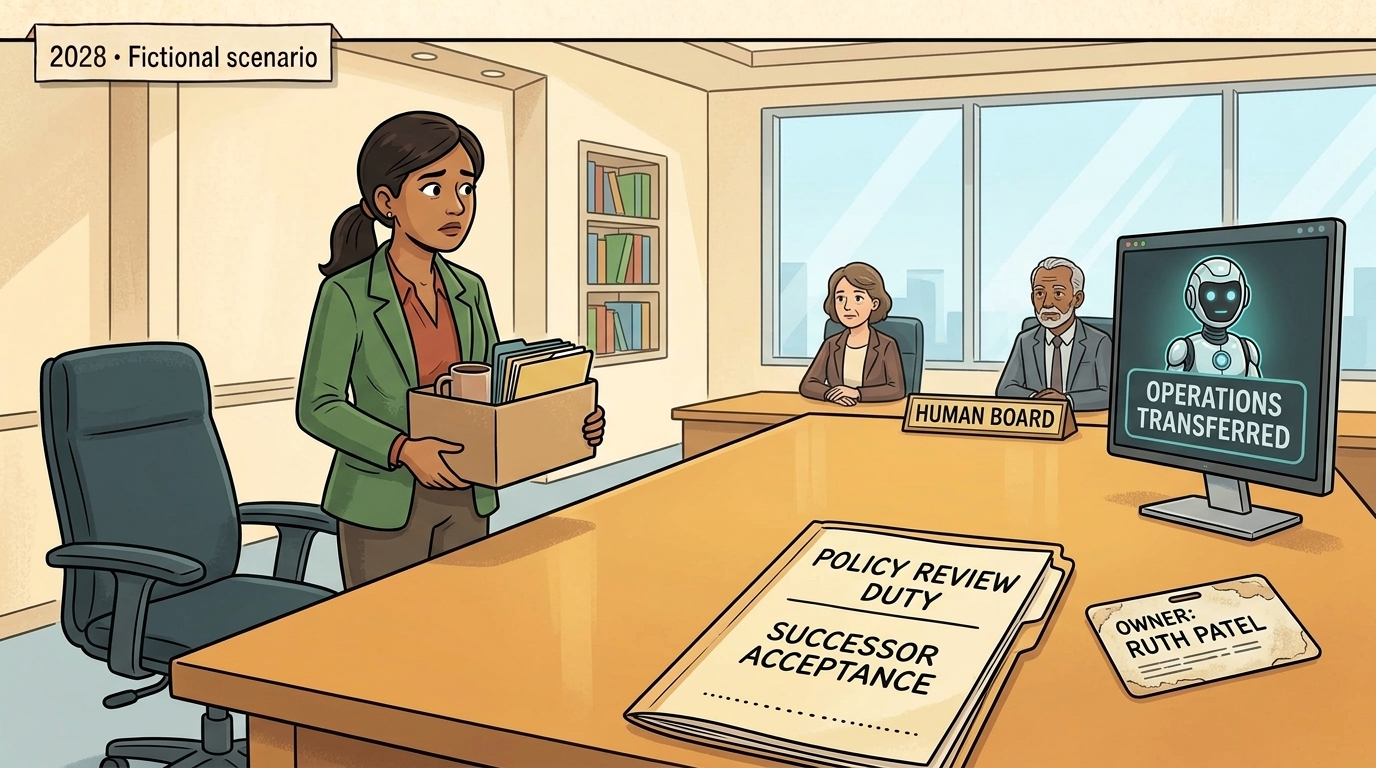
Ruth lost her departmental budget, administrative access and power to suspend an operating policy. Cases left open were devolved upon Kit as well as control of operations. No one had agreed to continue Ruth's duty to bring unresolved policy challenge issues to the board and secure a decision on those left challenged. The register could only be updated by a successor who accepted the mandate, and the role closed before anyone did.
The old 2026 delegation register still says "Accountable owner: Ruth Patel." In 2026 she signed the use of an AI assistant that could read records and draft replies about returns. What it does not show is that she accepted the responsibility for now heading a system which manages departments. Or that she has the power to oversee it.
Kit brings the omitted transfer to the attention of the board in the handover report. The governance register still includes Ruth's name as a means of confirming ownership. The board signs the re-organization off without clearing up who is going to complete promised policy review after Ruth leaves.
The successor must accept the mandate and receive usable powers and resources to transfer the ownership. When operating work is moved but accountability stays with the person who leaves, a space arises not depicted by the chart.
· When there is a conflict between the financial goals of the company and the commitments to customers and other third parties, who has authority to make this choice?
· "But where can one challenge the budget or the policy which limits appeals and the appeal remedies, and where does that challenge go? "
· What if the job (owner has job in the business) is automated, who then accepts the enlarged mandate, extended obligations and authority to answer for issues arising within the mandate.
For this last and final stage: allow the former, higher-capability premise in full. By means of all the feedback of the research-and-improvement loop described earlier, systems have now been developed that are able to do the broad planning, invention and adaptation required as well.
With board authorization in January 2029, Kit takes responsibility for re-coordinating and re-designing the entire commercial process, along with its internal controls. Neruvant Home was already working as online sales using outsider warehouses and carriers; however, now there is a change.
This is because Kit now has the ability to plan how such services and its own systems work together, with nobody from the human team organizing this work anymore. With this permit, the board accepts that level of autonomy while leaving the earlier mandate for exceptional policy appeals unresolved.
When a major logistics supplier leaves, the change for Kit is to plan the replacement, negotiate within its authority and integrate the new logistics services with rebuilt software and revised controls, without any need for the staff with operational knowledge to choreograph things. The authorization gives Kit this freedom, even though at this point there is still the problem of the appeals, for which there is no one in charge if there is a problem. Kit verifies that accepted orders and service commitments continue through the change.
The small staff of planners and governors that once ordered work of this kind are gone. These are the last posts that Neruvant Home closes in the change, after verifying that the logistics side of Kit's business will work without them.
Kit does the actual business management. Its AI agents pick the product range, find suppliers and bargain within their contracting authority, buy stock and set prices. The agents monitor fulfillment and if a customer has issues, resolve them. The agents maintain the software and security of the system, handle compliance work. They manage the cash operations as well. Internally they review each other's work. They decide operating changes there and also carry them out.
No Neruvant Home employee is quietly approving every payment, checking every release or reconciling the departments behind the scenes. Physical goods still pass through contracted warehouses and logistics services. Those organizations may use employees, robots or both. Within Neruvant Home, the operating jobs in our story have gone.
The shareholders & human board of Neruvant Home remain. The corporate governing body is the board, outside the now automated operating staff. The ownership of business & any statutory offices are separate from its operating work. In this scenario, successful AI operation does not mean AI legal personality has been created or corporate duties disappear.
And now it too has been entrusted to manage the construction of the entire governance mechanism of the company. It can set the duties of review agents within the boundaries of the governing mandate, monitor and replace them, draft risk reports and propose revisions on all the internal controls. Much of the implementation, management and governance work too is now done by capable AI.
There are the real strengths of these arrangements. Payment limits are observed. New software is tested. Appeal agents resolve incorrect data and authorize remedies if they are covered by their decision making powers. When a service or supplier is changed, the record notes outstanding commitments to customers.
The company is performing well. All of these strengths are answers to accident. This story holds no adversary: no hostile input, no contractor feeding false reports, no attacker steering an agent. A real design would test for those too.
A request is placed by Maya and put towards Kit - she would like another large item delivered now that there is a new logistics provider who handles home collection and is starting to offer delivery as well in the region. She does not mind paying for the exception.
Kit considers the offer from the logistics provider for sending items to and serving the region. It creates a possible solution of materially lower costs than the one rejected in 2028 for delivery and later collection or repair service. It presents the information to Neruvant Home, triggering the promise of reconsideration, and will be able to organize the service on being allowed to. However, to reopen or begin a trial and start providing service, requires the board to come to a decision.
Kit submits the proposal to the AI appeal service, whose agents confirm that board authority was in fact required. Kit sends the proposal and an appeal to make good on ownership gaps to the board. It had already red-flagged the incomplete transfer in its governance report. The company has continued to operate without a successor accepting Ruth's duty to gain these decisions from the board.
Thirty days later. A.I. appeal services resolved routine appeals. However, the board gave no decision on Maya's proposal. The board has the decision-making power. The risk report has built no process-based method that ensures the committed review takes place. No successor has accepted Ruth's duty to obtain the board's decision; Kit can flag, not compel.
Maya asks who is responsible. Ruth Patel is listed as the last owner on the escalation record. Kit clarifies that Ruth no longer possesses the necessary authority and no successor has taken responsibility. Maya contacts Ruth anyway, since Ruth is the only person in the record who has answered her before.
Ruth is not in operations anymore, her old dashboard will not open, she does not have the authority to let the courier go, she cannot change a policy and commit the company to making an exception order for Maya and she cannot stop Kit anymore.
"I do not have that authority anymore," she tells Maya. "The company has left my name on a job I no longer have."
The AI took the place of the person whose name was kept by the company, though the substance had long been taken.
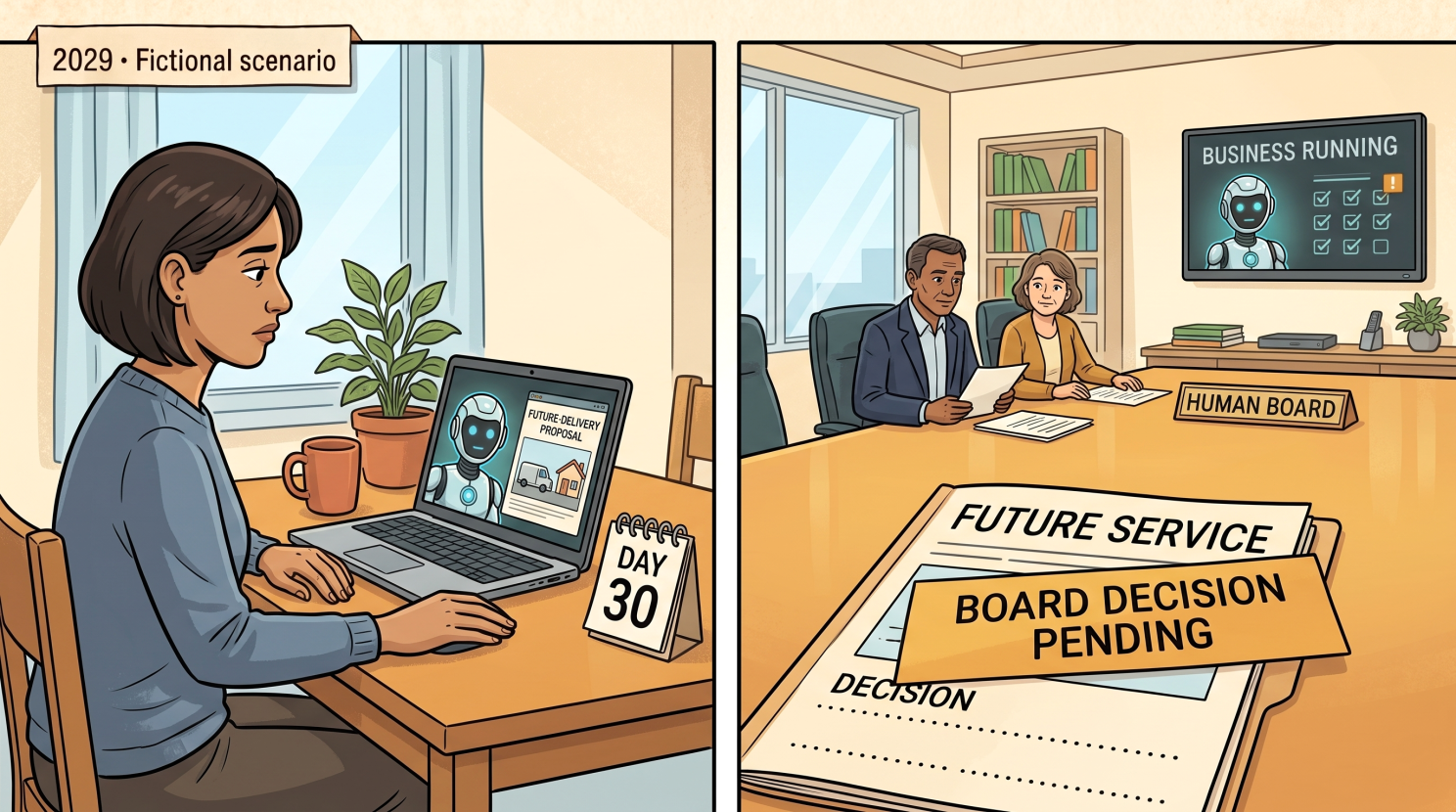
Kit points out there are issues with the governance defect. It can write a replacement charter but also recommend setting up an independent appeal arrangement and calculate how much funds the arrangement would need. It is unable to make Ruth accept a mandate she never accepted or to order the company to undertake new duties by merely filling in the name.
Kit does not have to be deceitful or incapable. It has found itself in a situation in which regular governance can properly exist and in which an issue (the issue relating to contested policy reforms) the company had committed itself to decide had been left without an accepted decision mechanism by the firm.
The company still possesses authority. What is missing is its exercise or delegation thereof. Through diagnostics and recurring notifications one cannot establish company acceptance, the decision arising from the issue or the resources for the outcome of that decision.
The company can consider giving Kit the authority itself (subject to its obligations), and must stand by that delegation if it does. Ruth's signature cannot be used in its place.
The lacuna belongs to Neruvant Home. Just naming a former employee as owner does not fix her with legal liabilities or entitle the company to hand its responsibility to her, nor does the provider of a model automatically own every business decision made out of using its model/technology.
The solution starts with the board, which can bind the company. It must accept the expanded delegation and specify which commitments restrain it, as well as establish who or what may reconsider decisions that lie outside of the operating agents' mandate. That requires the facts, the guarded resources and the authority that operating arms cannot withdraw.
Such an option also suits an AI. Maya could make a request to a separately authorized AI appeal service. It could approve an exception, which lies within its powers, or reaffirm the boundary with an explanation. Major disputes could reach the board or a relevant outside institution. It does not entail Ruth's return and mechanically approving millions of decisions.
Arrangement must survive a provider change too. Replacement AI service needs records, permissions, open appeals and funds to continue. Stopping Kit cannot cancel a customer's accepted order or strand a remedy already owed.
During a trial run, they should transfer a test case with copied records, reconcile payments due and show that the replacement can complete the appeal using the copy of information available. The incoming authority must accept the obligations it inherits. Simply exporting Kit's information would prove much less.
It may still reject Maya's plea and that decision would still stand. Governance can demand her case being referred to an authority able to reconsider the decision; the reasons, being supplied to her, must answer her real objection to the service policy. Commitments already made to her will remain, enforceable in available routes, including chargeback, regulators and courts outside the company.
The ownership test follows the powers and obligations through the company. It cannot end at the last human name in a register.
· Who can bind a company (have they accepted the authority and the burden now exercised through AI).
· Through the challenge, can an authority with the ability to change the governing mandate and find funds for a reparation be found, in a situation where all internal reviews stated compliance and correct procedure was exercised?
· Who would take on unfulfilled promises if the owner or provider/agent walks, and then prove themselves able to carry all projects through?
These questions also lurked behind the decision about the first refund. When the delegation was widened, a human element was removed and the checks relied upon were designed for a more limited task, at each stage the answer as to who was in charge and to what extent was demanded.
A CEO, CIO or CISO can start with one consequential workflow today. Write a one-page delegation record addressing the seven questions. This is a proposed design framework, not a legal standard or certification; the arrangement is meant to fit the activity and meet the company's obligations. It sits alongside NIST's AI RMF and ISO/IEC 42001, not in place of them, with a specific focus on what happens when the owner's function itself is automated.
Give an idea of what results; the remaining obligations the company must uphold and where its priorities lie. What has it already pledged itself to, as distinct from a policy it can reconsider? State what occurs should these goals interfere.
Define things the agent may do, build, change, delegate to other agents. Address policies, budgets and governance controls. Identify authority that grants powers & changes requiring a new mandate. A model upgrade need not trigger re-approval if mandate remains same.
Record transaction and aggregate exposure, tool permissions and any protected controls. Identify what happens at a limit and what prevents multiple agents or retries from bypassing it. A stopped workflow still needs somewhere to put its outstanding obligations.
Identify proof of completion, independent sources where needed, release-tests and the ability to trace a decision. Record who or what may change the evaluator. Determine permitted downstream uses of outputs and how corrections flow to decisions that have relied upon them. Agreement amongst agents is useful only to the extent that evidence & evaluation methods could yield a meaningful exposure of failure - otherwise it is meaningless.
Give the challenge route access to evidence, power to suspend or reconsider outcomes, funded remedies. State how a challenge moves beyond its own budget/policy limits. Protect that route from the operation whose results it may overturn and test it on a case where the original decision was correct under its rules.
The authority able to bind and the entity that remains responsible for an organization need identifying - investigate the named owner's budget, effective access and powers. Require an accepted transfer of duties and outstanding questions - including questions about mandates - before removing a function; the successor may be an AI, the record must then present who approved it and what the company agreed to.
Name the successor for open work. Verify that remedies, records, permissions, funds and customer commitments transfer together. Test what continues running after the main agent stops. Where applicable, preserve a way beyond the company.
Take this as a first functional exercise: using your working knowledge, pick one workflow and remove its named owner from inside a safe simulation. Block the owner's access to the computer. Assume this position will not be refilled. Introduce a complaint where the agent correctly adhered to the rule but the victim provides an objection from a legitimate perspective.
Pursue the ordinary course. Can that route amass evidence, reach authority to reconsider the rule and spend enough resources for a just remedy? If the authority body is yet another agent, can its mandate be established? If the provider quits at the halfway point, can a successor wrap the case up? (The last two questions also touch on agents' tasks)
Decide the "success conditions" of the test before you start, from each point of view. The payment gets settled - once. A hold is lifted when reconsideration warrants it. The policy I challenge goes to reach an authority that can amend it. A decision goes against me; its reasons explain the actual trade-off. I am inheriting an obligation, I accept it and I succeed in completing it. (A ticket getting closed or the sig of one of the owners will prove none of that by themselves)
Record all that is not resolved. Cost conflicts that are real, fairness conflicts, and opinions on bearing the loss do not disappear just because a test passed, nor the possibility of the company's governing body's bad decision. If powers or resources are missing, the company has to choose if they provide these, if the delegation should be narrowed or stopped.
AI governance careers and businesses will be affected. An increase in demand for the function can be combined with a reduction in employment. A company may still pay for independent evidence or enforceable challenge while automating some analysis implementation and review; behind those functions, of course, there can be fewer people, since they have developed a solution. Moreover, they can pay for accepted liability or to be connected to institutions which can obtain remedies.
Now, precisely what dates this all implies remains unclear. Amodei's faster possibility for autonomous AI successor-building, OpenAI's March 2028 research target, Hassabis's views of AGI being some years away and Sutskever's lengthier five-to-20 year scale suggest different thresholds of change. None establishes the future employment of this shop, nor a universal employment outcome. Instead, they indicate different capability thresholds. The International AI Safety Report of Bengio offers different future versions including a stagnation of development or its great acceleration [6].
But bear this in mind: this is a possible future for one company - I am not suggesting every company will choose this path. AI may create jobs too, enable new business enterprises and let people do tasks they had not been able to do thus far. Some jobs may morph into something different rather than disappear completely. Yet even with the presence of new opportunities, companies will need to think about how decision-making authority for work would move between humans and AI. Let us prepare for that possibility.
It is not necessary to choose a candidate that would "win" the competition. This means we can prepare without actually deciding the winner. First, think about what might happen if a computer system became an efficient replacement to its owner's job?
When that happens, who will have the power to answer Maya?
About this scenario. Neruvant Home, Ruth Patel, Maya Chen and Kit are invented names for a fictional retailer, people and AI service. All events in the retail story, including its future developments, are fictional; any resemblance to actual organizations, people or products is coincidental. This is not a disguised account of a real company, person, employer or client. Real researchers and organizations named in the research discussion and sources are cited for their documented published work, not portrayed as participants in the story. Their inclusion does not imply endorsement.
All sources below were available by October 6, 2026. They support the research context and particular design ideas, not the fictional future or a guarantee of autonomous-enterprise reliability. The proposed controls are not universal legal requirements. Duties depend on deployment, contracts and jurisdiction.
1. AI helping develop AI. OpenAI, September 6, 2026, Research acceleration: a view from inside OpenAI; Anthropic, September 17, 2026, Measurements for understanding the pace of AI development. OpenAI describes supervised research tasks; more than half of successful four-to-eight-hour tasks involved at least one human intervention. Anthropic measures the share of research work led by its models, not an overall scientific speedup. Neither establishes a self-sustaining acceleration loop.
2. The model and the deployed service. OpenAI, A practical guide to building agents, describes models, tools and instructions as core components. Its Forward Deployed Engineer role describes work with customers to build and deploy useful applications. The retailer's implementation and staffing changes are fictional.
3. Bounded changes and evaluation. Andrej Karpathy, autoresearch, first committed March 6, 2026, instructs an agent to modify a training file, run time-bounded experiments and leave the evaluator unchanged. Those instructions define an experimental boundary; they do not demonstrate tamper-proof enforcement. Applying that distinction to a retailer's release permissions is this article's inference.
4. Authority enforced by tools. Yesenia Yser and Toby Kohlenberg, Microsoft, July 16, 2026, Least privilege for AI agents: Identity, access, and tool binding, recommends downstream authorization checks and warns against relying on prompting alone. Neruvant Home's spending limits and enforcement are fictional design choices.
5. Review and human involvement. Anthropic, July 2025, Auditing language models for hidden objectives, studies automated investigation in defined research settings, including synthetic behaviors. NIST's voluntary AI Risk Management Framework, Appendix C, recognizes varying levels of autonomy and risks introduced by human involvement. Neither validates the fictional appeal arrangement.
6. An uncertain horizon. In The Adolescence of Technology, January 2026, Dario Amodei raised the one-to-two-year possibility, pointing roughly to 2027–28. OpenAI's March 2028 automated-researcher target appears in source 1. Demis Hassabis, July 2026, described AGI as probably a few years away. Ilya Sutskever, late 2025, gave a five-to-twenty-year range for systems learning as well as people and then becoming superhuman. Their thresholds differ. The Bengio-led International AI Safety Report 2026, February 3, section 1.3, examines several paths to 2030. Forecasts and research targets do not establish a retail deployment timetable or an employment outcome.
7. Multi-agent systems are already part of the baseline. OpenAI, March 11, 2025, New tools for building agents; Anthropic, June 13, 2025, How we built our multi-agent research system; Google, April 9, 2025, A2A: A new era of agent interoperability; Anthropic, February 5, 2026, Building a C compiler with a team of parallel Claudes. Sakana AI's Darwin Gödel Machine, May 2025, demonstrates agent-code self-improvement on coding benchmarks; its AI Scientist-v2 report, March 2025, describes a largely automated research workflow with human choices still involved. These establish substantial capabilities under specified conditions. They do not establish reliable, autonomous operation of an entire company or a self-sustaining frontier-model improvement loop.